

Multidots is now WordPress VIP Gold Partner
We are proud to share that Multidots has moved up the ranks again and is officially a WordPress VIP Gold Partner! When we first became a WordPress VIP Silver Partner in June 2019, only 34% of the web was taking advantage of everything WordPress had to offer. Now in 2022, 43% of the online world is powered by WordPress, and as a VIP Gold Partner, we’re ecstatic to have contributed to that growth.
For those who are unfamiliar, we are a global development agency that helps publishers and digital organizations maximize their website performance with plugins and services that are efficient and 100% results-driven. With our excellent IT and Engineering teams, we’ve been able to collaborate on and successfully execute mass-scale projects with major enterprise clients like National Associations of Broadcasters, News Corp, PMC, and Ask Media. Thanks to our efforts, our clients all now have personalized environments that are secure, agile, and fresh.
Besides our clients’ success, being a part of the WordPress VIP Partner program and working with the VIP team at Automattic has exceeded all our expectations. We love working with them because they not only have provided us with the best tools and resources to succeed, but they are our loudest cheerleaders. They’ve supported us and have given amazing guidance when we’ve run into obstacles.
We may be biased, but our entire team continues to show why Multidots is a leader in the WordPress field. The drive, kindness, and poise under pressure we have are the keys that keep us and our work competitive and innovative.
We Help Publishers Succeed
As a progressive leader in publishing solutions, we have shown how hard maintaining efficient and profit-focused editorial workflows can be for technical teams at publishing organizations. These teams have too much to handle because many of them are still trying to use out-of-date tools and processes to update their websites and get content published. Because of this, they usually don’t see that they are wasting time, labor, and revenue that could be invested back into their organization.
Ultimately, we got fed up watching publishers not reach their fullest potential, which is why we decided to share our expertise and partner with technical teams to help them optimize their workflows and ecosystems for premium efficiency and performance.
A few of our key tools and services that will help streamline publishing process and business efforts include:
Multicollab
To say our plugin, Multicollab, is a gamechanger is an understatement. The plugin brings Google Doc-style editorial comments to WordPress to simplify your publishing experience. With just this single tool, you can invite others outside of your team to collaborate on pieces, add comments to any post or media, and have your technical team keep track of all activities on the Advanced Dashboard.
Multicollab is 100% compatible with the Gutenberg Block Editor for WordPress, which means that you can confidently make better edits and transform your content in real time. You won’t have to worry about comments or requests slipping through the cracks or your team losing track of deadlines.
Migration to the WordPress VIP Platform
Remember: just because you think that your website is good doesn’t mean it can’t be better. As a VIP Partner, we can help you migrate your existing WordPress website to the VIP platform so that your tech teams can have access to fresh support, flexibility, and performance features that will transform your editorial needs and keep your business competitive.
Having the migration option is crucial for publishers because their website needs will change as they refocus goals and improve editorial processes. If your technical team doesn’t have the resources they need to help your website keep up with all the changes, you won’t be able to convert visitors into customers — no matter how good your content is.
How We are Changing the Online World
Years ago, we wouldn’t have believed anyone if they had told us that every line of code we were going to create would touch millions of online users and transform technical teams everywhere daily. That quickly became a reality for us and we’re glad that we’re trusted as a principal voice in the WordPress community.
As stated on our Impact Page, we’ve already been able to reach 100+ million people through our coding, and we hope to hit 1 billion very soon by continuing to provide more meaningful publishing experiences, and streamlined, results-driven workflows.
References
Celebrating 11 Years of Serving People and Solving Problems!
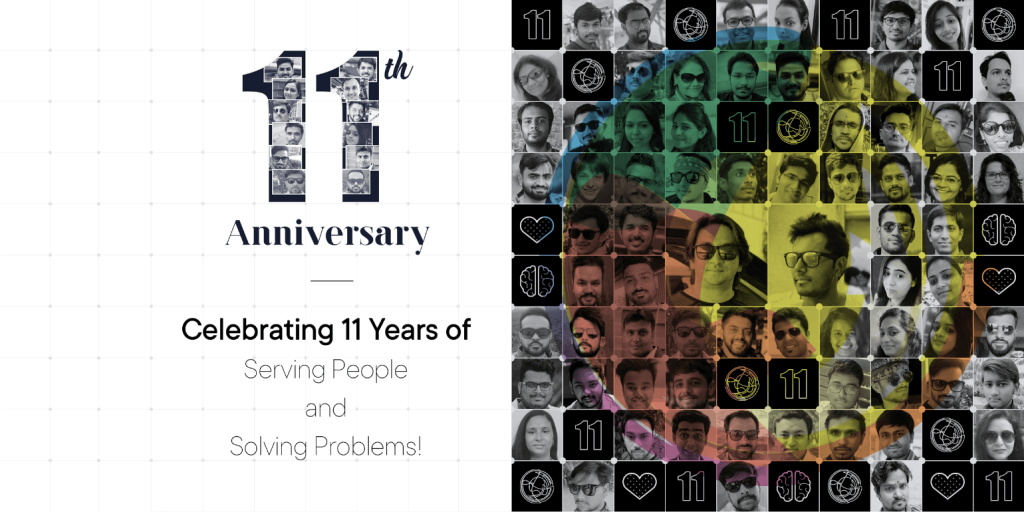
What a moment! Our baby, Multidots, was born during the recession of 2009. Today, we are celebrating its 11th birthday amid a pandemic and crisis. We wish it would have been born with some immunity for recessions as well 🙂
It has been an incredible 11-year journey. Every passing year we have created new memories, which will make for great stories to tell.
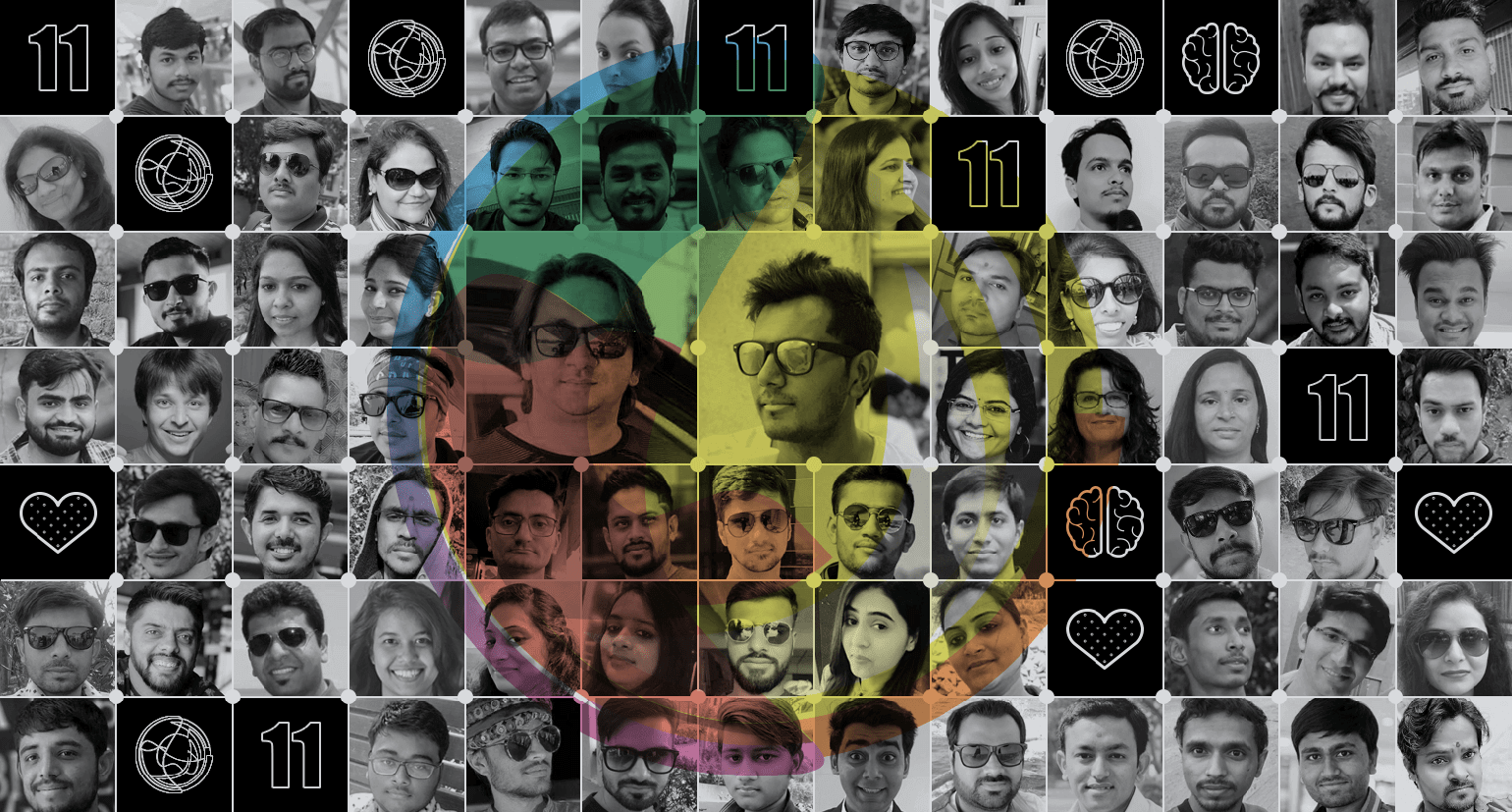
We are grateful for our 12 loyal and “oldest” Dots — Chirag, Mayur, Nidhi, Kaushik, Bhavin, Parth, Tejas, Rajvi, Sagar, Nishit, Nitishchandra, and Nimesh, for their significant contributions, their dedication, and their confidence in the vision of Multidots. We feel honored and pleased to pay a small tribute by featuring them on our anniversary doodle.

Multidots is a combination of all these smart Dots who are driven by their passion for solving problems and serving our clients. Their incredible minds have solved thousands of new problems, and their commitment has brought a big smile to our clients’ faces during these 11 years. They are not just the faces on our anniversary cover, but they are the faces behind the scene, providing exceptional services to our clients for the past 11 years.
Today, we are celebrating:
- The spirit of striving and surviving
- The commitment of care and compassion
- The excellence of engineering and efficiency
- The act of heart and mind
- The passion of serving people and solving problems
…and we are celebrating all those joyful moments, incredible stories, and life-long memories which all us Dots (as well as ex-dots) have created together—looking forward to creating new and more magical moments in the years to come!
Dots around the globe are celebrating the Spirit of Work From Home and showing their cooking talents

March 29, 2020


Anil Gupta
(CEO & Co-Founder)
Anil kicked-off the challenge by showing his latent talent of brewing a black (drip) coffee. He also explained a bit about the types of coffee and different methods to brew coffee. ☕
March 31, 2020


Jeremy Fremont
(Director of Business Development)
Jeremy showed his cooking talent by preparing delicious Lemon Ricotta Pancakes. It melt-in-your-mouth soft and tender, fluffy, and you’ll love that bit of brightness and tang from the lemon. 🥞
April 04, 2020

Vibha Tiwari
(Manager – QA)
Vibha prepared a loaf of Roti (Indian bread), Yellow Dal, & Steam Rice using traditional recipes. She used a variety of ingredients to prepare this food dish. 🙂
April 04, 2020

Mary Jane Zorick
(Technical Account Manager)
MJ showed her cooking talent by preparing a very American comfort food – Chicken Potpie and yummy Banana Muffins with Chocolate Chips. 🥧
April 05, 2020


Kushal Dave
(Business Development Executive)
In this unique challenge, Kushal showed his hidden talent of brewing a Dalgona Coffee which is trending in India during this quarantine time. Indeed, it is mouthwatering. Isn’t it? 😋
April 13, 2020


Deval Talati
(Manager – Operations)
Deval cooked a Spinach Potatoes Vegi, Roti (Indian Bread), & Steam Rice using traditional Indian recipes. “Cook Healthy, Eat Healthy Food, & Stay Healthy”. 🍲
April 13, 2020


Kaushik Baroliya
(Manager – Creative Designs)
Being a food lover, Kaushik prepared a spicy traditional Gujarati food – Dahi Tikhari & Bhakhri (Indian Bread) using different spices & yogurt. 🌶
April 19, 2020


Nishit Langaliya
(WordPress Developer)
Comedy King, Nishit showed his cooking talent by preparing the hot favorite Indian fast-food dish “Pav Bhaji” using different fresh veggies & spices. 🥦
April 19, 2020


Meet Makadia
(WordPress Developer)
Meet prepared one of the most favorites breakfast dish “Bataka Pauva”, Light & Healthy. It seems very tasty. Recommend to try this dish in your breakfast! 👌
April 19, 2020


Mayur Keshwani
(Manager -WordPress)
Tempting & Crispy Veg Frankie has prepared by Mayur which shows his hidden cooking talent. It looks cheesy & yummy. 😍
April 24, 2020


Nimesh Patel
(Manager – Product)
Crunchy & Unique “Maggi Bhajiya” has prepared by Nimesh adding a flavor of tangy tomato ketchup. Delicious! 😋
April 26, 2020


Chirag Patel
(Manager – WordPress)
Chirag prepared the delicious “Peanut Sweet Roll” with all-natural and wholesome ingredients that fill your mouth with an exotic sweet taste. 😍
April 27, 2020


Hitendra Chopda
(WordPress Developer)
Light & Healthy! Yes, “Swaminarayan Khichdi” was cooked by Hitendra with vivid ingredients & fresh veggies. 👌
April 27, 2020


Janki Moradiya
(WordPress Developer)
People who love to eat spicy food, this dish is especially for them. Yes, one of the popular seasoned Rajasthani dishes “Daal Bati” prepared by Janki with a spicy tadka. 🌶
May 10, 2020


Jay Upadhyay
(WordPress Developer)
Jay added the taste of Punjab by preparing the delicious “Dal Makhani & Naan”. He used vivid ingredients & spices to prepare this food dish. 🥣
May 17, 2020


Kushal Shah
(WordPress Developer)
Kushal prepared a variant of Maggie named “Creamy Cup Maggie”. It looks very velvety 😋
May 26, 2020


Priyank Patel
(WordPress Developer)
Priyank baked alluring “Choco Muffins”. Homemade muffins are so much better than anything at your corner cafe. It looks very fresh & yummy. 🧁
Our response and readiness for business continuity during the Coronavirus (COVID-19) pandemic

This is a novel time in our history. The COVID-19 pandemic is having an impact on the health of many families, the businesses we rely upon, the health of the global economy, and the way we live our daily lives. As we all continue to navigate through these unprecedented and evolving challenges, we want you to know that Multidots is here for you and prepared to face the challenging phase.
In our more than 10 years of business, we’ve weathered the storms of the Year 2008-09 financial crisis and the recession that followed, city/state level curfew, internet outage because of curfew and fire in our office which had touched our regular office life badly, and throughout this journey, our mission of Serving People, be it our employees, our customers and our partners, remained our top priority.
All these unfortunate events taught us that ‘it’s never too late’ to kick-start the work on Business Continuity Plan. Also, we have been always kept on updating our learning from the events, which has helped us so far to remain better positioned to recover from the business interruption, financial impact, and loss of life that a natural disaster or man-made event may cause.
Having a pre-defined and well-documented business continuity plan has helped us to clearly communicate how our business will respond during such an unfortunate event — and indeed, is one of the best investments our company has made. As we address a pandemic there is no doubt – it will become a chapter in the history books. However, in this challenging phase, our commitment to Serving People will remain unchanged.
The intent of sharing our readiness in the form of a Business Continuity Plan is to provide assurance to our existing and prospective clients that Multidots is enabled to respond and ready to recover from a disruption.
People
Supporting our Dots during this period is one of the priorities and they are equally showing ownership in providing the services our clients need and expectations. We have taken all necessary actions as soon as COVID-19 has started spreading,
- To protect the physical well-being and financial security of our employees so that they are in a position to care for their health while also supporting work routine.
- Preparing our team for remote work. At present, 100% of our global workforce is working remotely.
- Dots have adequate facilities like high-end internet connectivity, proper home office set-up which will help them to maintain productivity.
The commitments we have made to support and care for our Dots ensure that we are ready and equipped also to support our clients during this uncertain phase.
Backup
Be it Project, Resource or Internet backups – We Are Ready!
- As per our standard practice, we keep up to 15% of engineers on the bench. While on the bench, we utilize them for internal tools, training and research work. We allocate these resources to live projects in case of an emergency.
- All the project managers & technical leaders are closely connected with the internal weekly process meeting. In case of a need for a resource, they can easily sync up with each other.
- We are confident to handle up to 15% of team fluctuation. In the case of greater impact, where team fluctuation reaches more than 15%, our first preference is to talk to our other ongoing projects/customers to understand their priority and check if we can release resources and serve the urgency of other projects.
- In the worst-case scenario, if the team fluctuation is >15%, that is a scenario where we will come back to you to find alternate solutions. We have trusted strategic partnerships with other small but skilled development agencies in India, and we are prepared to lease developers from such companies with short notice.
- Being a WordPress agency, we have all our developers trained to follow our best practices including, development workflow, coding standards, and advanced WordPress knowledge. Thus, our developers are easily able to swiftly, pick up the new project in between, with a quick Business Logic knowledge transfer.
- Daily scrum meetings are in our blood. When working in a team, each person in the team is aware of the latest status of the project. In the scenario, when a Project Manager is unable to work, a Team Leader or Technical Analyst or other Project Manager (we have a team of 6 project managers) can take over the project in case of urgency. Daily scrum meetings allow another developer to pick up a team-mate’s task in case of short term unavailability of a developer.
Internet
All our global workforce has a high end – stable internet connectivity. Hence we face negligent to minimal work disruptions due to internet connectivity. In addition, Internet connectivity and Electricity in Large/Mega/Metro cities have been most stable and in its best phase from the last 4+ years in India and fortunately, our majority of team members are located in large cities like Ahmedabad, Bangalore, Bhubaneswar, Delhi or Mumbai. Hence, internet connectivity has not been a concern.
All our employees have a stable broadband internet connection and use one of these broadbands while working remotely:
- Airtel Broadband
- GTPL Broadband
- You Broadband
- Reliance Broadband
Also, all of the team members have a backup option of 4G cellular connectivity in case their main broadband network is down. 4G is wide with good coverage.
Data Security & Protection
As a dynamic & trusted WordPress VIP Agency, our processes are fully derived to be compliant and we take ownership to maintain the safety & security of your valuable data. Integrity is our fundamental value and makes up the core of our corporate philosophy keeping us committed to center our engagement around this approach.
Date Security is critically important to us and we believe it is important for our clients to understand how well equipped we are.
All our servers are hosted on the cloud and fully secure with
- Advanced Cloud DDoS Protection
- Redundant cloud backups
Server Connectivity
- All staging servers can be managed through VPN only
- VPN connection rights are given to authorized Dots
Tools
Our process/tools are designed to support remote work. For Project Collaboration we use Basecamp or Teamwork which are on the cloud. It is easy to assign access to the new developer. Our Development workflow is integrated with Github CI/CD workflow, and our staging servers are in the cloud. Thus, this can be assigned easily with the right permissions.
Below are the tools we actively utilize to keep a track of all project-related conversations:
- Slack – As per our process, for all running projects we create a project-specific channel i.e. “prj-<project_name>”. We also invite our Client on the same slack channel. This way all the project related conversation stays synced.
- Basecamp – PMS to document/collaborate all project-related communication.
- Teamwork – For Internal Task Management and Issue Tracking for all the projects. So any new developer can ramp up.
- Zoom – Real-time Video Conferencing
- Dialpad – For Leaders/Project Manager Direct Phone support
- Github – Project Source code and Version Control Management
- GSuit – At Multidots we use Google GSuit for our needs like Mail, Google Documents which is easily available to our team without any downtime.
Our bit in the COVID-19 phase
The following are some actions being taken to protect our clients, our people, facilities, and workloads.
- We are extending the validity of support bundles for the clients who have purchased or willing to buy.
- Dots are happy and flexible to adjust work hours to meet our clients’ new routine and work schedule if any.
- Our HR & Operations team is continuously monitoring the situation and working tirelessly to help and educate our team to stay safe, healthy, and motivated.
- We have created a Special Support Squad for our Dots which will be there for the team to provide morale to finance support.
Without a doubt, our greatest common achievement is how we have all reacted in challenging times. Dots, clients, partners, vendors, and support staff have all contributed tremendously to keep our operations running.
Normalcy will return. These are testing times, but our small Dots community has, we firmly believe, met that test so far.
References
A very big 2019
We’re honoured to be one of the select few official WordPress VIP Agency Partners. With our participation in the VIP Featured Agency Partner program, our WordPress development services come with the extra benefits of the added security, flexibility and performance that most of our high-volume and enterprise projects demand.
The World of WordPress
WordCamps
With great enthusiasm, we were able to be a part of 11 different WordCamps across the globe in 2019 – WordCamp Pune, WordCamp Bangkok, WordCamp Kolkata, WordCamp Europe, WordCamp Nagpur, WordCamp Vadodara, WordCamp Udaipur, WordCamp USA, WordCamp for Publishers, WordCamp Düsseldorf, WordCamp Ahmedabad and proud to be volunteers, speakers, sponsors, and organizers of some of the WordCamps.
Happy Morning, WordCampers! All set for the day. Don’t miss to visit our booth if you are at @WCAhmedabad and say Hi by grabbing some exciting goodies. Multidots team is eager to welcome you at our booth. #WCAhmedabad #WordCamp #WordPress pic.twitter.com/tev79TGeLZ
Multidots (@multidots) December 14, 2019
What a Vibrant and Inspiring @WCEurope was!! Our COO @aslam4net and Dot @afsana_multani shared their amazing experience at @wpcafe with wonderful people. See you all next year for another amazing WordCamp Europe 2020 in Porto. #WCEU #WCEurope #Multidots #WPCafe pic.twitter.com/9lUoHUKXcK
Multidots (@multidots) June 24, 2019
Do_action charity hackathon
Multidots team and other community members from Ahmedabad (at our headquarter) organized the do_action charity hackathon and helped 6+ local non-profits to build their brand new websites.
Big applause for all the participants who contributed in Do ction charity Hackathon. #WordPress #Multidots #DoAction #hackathon #charity #WordPressCommunity #Event pic.twitter.com/xFyrvGuBX0
Multidots (@multidots) September 7, 2019
Big Talk at BigWP NYC
Our CEO & Co-founder, Anil Gupta talked about the engineering excellence that our team at Multidots demonstrated by leveraging the REST APIs to power the CNN of kicks and one of the largest digital publishers of NYC.
Five for the Future
Five for the Future encourages organizations to contribute five percent of their resources to WordPress development. Multidots pledged to sponsors 7 contributors for a total of 28 hours per week.
Sneaker News Case Study featured at WordPress VIP
We could not be more proud when our work on Sneaker News got featured by WordPress VIP.
Wish you had more time on your hands? Check out how our partner @multidots used the REST API to help sneaker mavens @SneakerNews reduce operations time by 65% https://t.co/4ze1nwROEG pic.twitter.com/QDioST9SDM
WordPress VIP (@WordPressVIP) January 17, 2020
- 60% of dots contributed to WordPress. Kudos to all our dots! 🎉
Our wall of fame
- We dedicate our selection as “Top 1000 Global B2B Companies” on the clutch to our clients for trusting us, and our team for delivering that trust. We are honoured to be featured in the Clutch 1000.

Our CEO, Anil Gupta has the honor to talk about our Passion for “Serving People” at the forum on “Doing business between India and USA” organized by Official Dulles Regional Chamber of Commerce, Indo-American Chamber of Commerce, and Fairfax County Economic Development Authority.
- A podcast hosted by Brian Krogsgard from PostStatus and our own Anil Gupta on a candid talk about establishing a very people-first culture at Multidots.
Have a look at our CEO @guptaanilg sharing his vision with @Krogsgard about his journey & philosophies behind building Multidots @ https://t.co/YH2czdW47x pic.twitter.com/PrG4OPkC61
Multidots (@multidots) February 8, 2019
- Asif Rahman did a podcast with our co-founders, Aslam and Anil. They covered great length and detail of Multidots’ origin story, journey, Ups-downs, cultures, and goals.
The Intro of Episode 4 of ‘Adda with Asif’ is coming live! I have @aslam4net & @guptaanilg , the co-founder of @multidots ! Here they told the story behind their name #Multidots ! Watch – https://t.co/P5RaVLgS2z #AddaWithAsif #WordPress #Entreprenuer #story pic.twitter.com/yzMEBiqEKl
M Asif Rahman ⓦ (@Asif2BD) January 13, 2019
- Multidots Foundation organized the “Fight Against Hunger” event and distributed food hampers to needy people. Multidots foundation is a humble effort by our team at Multidots to give back to the community.
Charity for Humanity
Multidots (@multidots) April 29, 2019
If you can’t feed a hundred people then just feed few.
Multidots Foundation organized “Fight Against Hunger” event and distributed food hampers to needy people. https://t.co/W59MJDg60K #MDFoundation #MD10thAnniversary #Donation #Charity #Multidots pic.twitter.com/zfQBUNC1Vn
Our Global Footprints
We are always excited to meet new folks, share ideas, and learn. Hence, we travel, attend conferences, and meetups across the globe. Here are some of the events & conferences we went to.
- We had a blast exhibiting at LeadsCon, Vegas event with our strategic partner Pressable. LeadsCon is one of the world’s largest conferences for the lead generation and performance marketing industry.
It’s been a great day so far at @leadscon.
Pressable (@Pressable) March 6, 2019
Website performance is key when you’re investing in driving traffic to your site!
And both of our CEOs are having fun! @guptaanilg from @multidots and our very own @JayNewmanTX. #LeadsCon Booth 1218 pic.twitter.com/KeESXvM2NH
- Our CEO and Director of Business Development, Jeremy Fremont had a great time during PubCon, Vegas event connecting with people and businesses in the internet marketing industry.
- Our participation in SMX East, New York gave us great insights into the importance of SEO in the publishing industry and enables us to serve our clients better.
- Attending the Affiliate Summit East and Multidots Sponsored brunch during the event helped us to connect and build face-to-face relationships with online publishers, influencers, media owners, traffic sources, advertisers, global brands, networks, technology firms, agencies, and other solution providers.
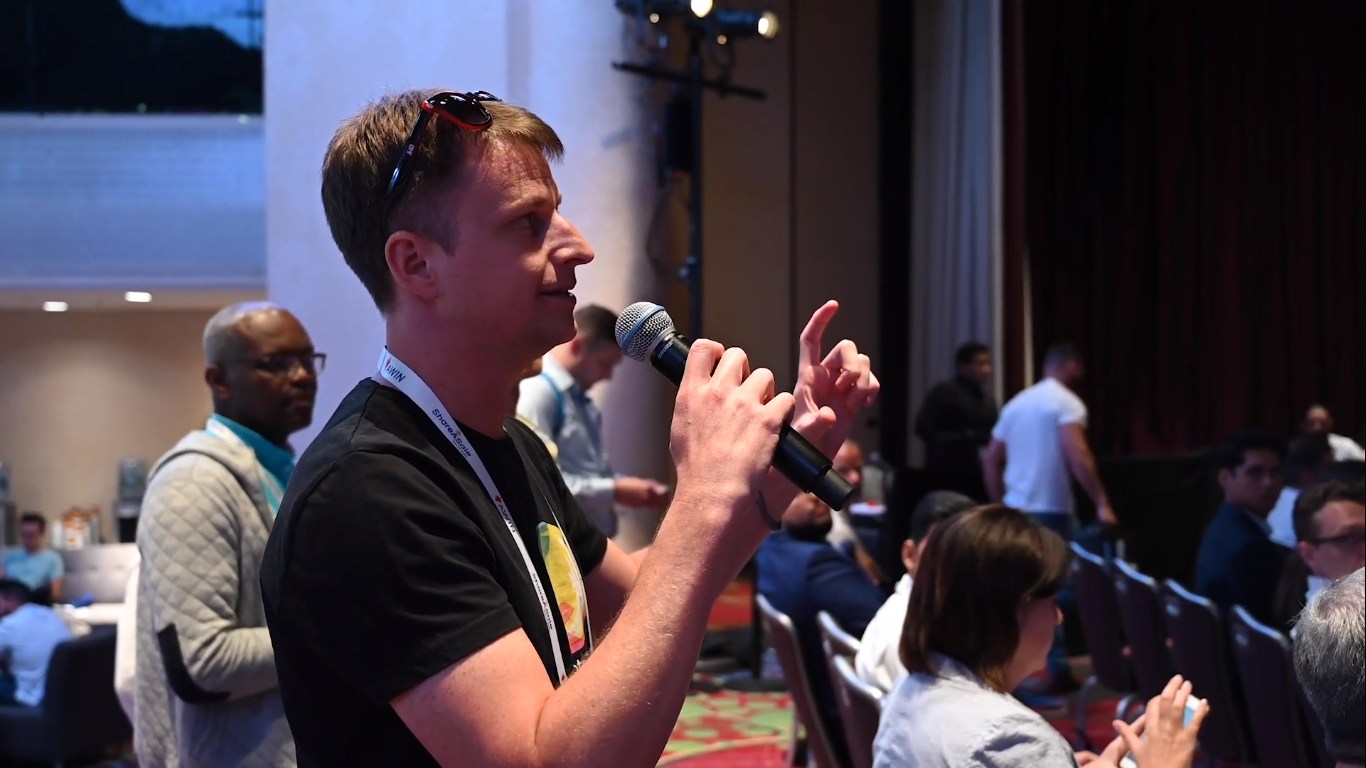
- Multidots team attended and sponsored Laravel Meetup in Mumbai and had a great time connecting with key influencers, contributors, and experts in the Laravel framework and community.
- Our COO and Co-founder, Aslam Multani, participated at Google for WordPress Publishers in Bangalore to fuel his obsession with website speed and performance on mobile devices.
Amazing speaker with good sense of humour to make session interesting and full of knowledge boast up community of WordPress and developers engaging more and more ,thank you @googleindia for such a wonderful meet-up look forward for more and more… #GFWP #GfWPINDIA #wordpress pic.twitter.com/nR2mNcvxOA
Khadija Shabbir (@khadz4) November 21, 2019
Noteworthy Highlights
- Multidots and Pressable entered into a strategic partnership. Pressable offers a unique value proposition of low-cost but high-tech hosting infrastructure and high-touch customer services that makes them a great fit for our customer’s hosting needs.
Multidots is very happy to become a strategic partner of @Pressable. Let’s multiply our performance capabilities with the best growing agency. https://pressable.com/strategic-partners/multidots/… #Pressable #PressOn #Multidots #StrategicPartner
— Multidots (@multidots) July 12, 2019
Our website speed and performance tool – SpeedOMeter powers Pressable’s customers and users to test their website speed and performance issues.
- We have joined the Performance Marketing Association as Solution Providers to help Advertisers and Publishers to maximize their revenue.
A BIG welcome to new member @multidots . Your membership makes a difference in our industry! #performancemarketing
PMA (@pmassociation) June 26, 2019
- We also became a member of Leads Council. As a member of the Leads Council, we get an opportunity to member-exclusive events, forums, research that help us to gain key insights into the lead generation industry. It’s an added-value for our clients to work with us as we talk the same language and terminologies.
- DotStore – a venture of Multidots released few new plugins and several other version upgrades to existing plugins. With 20,000+ download and 7000+ number sales, our DotStore serves and helps store owners around the world to run their online-shops efficiently.
- Our new SaaS venture – Ruvvu made a debut in 2019. Ruvvu helps business owners around the world to collect and manage business reviews at an affordable price.
- We have launched a new WordPress plugin – WPBRicks which offers 100+ readymade Gutenberg blocks design options to build awesome websites with just a few clicks.
- A day in Multidots, video premier that showcases our culture, traditions, and routine at Multidots.
- We launched a brand new website of Multidots that truly reflects our vision and commitment to serve and help “content publishers” around the world.
The Culture of Celebrations
- As like every year, we have celebrated the festival of happiness with different events starting the first day with an “AdMac – Season 6”, second day “Hawaiian Day”, and on the third day, we have invited the creative tattoo artists to make sure that the year ending of our dots are remarkable. We had lots of fun, laugh, & of course enjoyed the delicious food.
With lots of fun & sweet memories we have completed the “Hawaiian Day” and the winner of this beautiful day is @YearOfTheHulk – Mr. Hawaiian & Snehi Patel – Ms. Hawaiian. Congratulations guys! 🏆🤗 #ChristmasCelebration2019 #Day2 #HawaiianDay #MDCulture pic.twitter.com/pKxey9yioT
Multidots (@multidots) December 30, 2019
🔥Creative Tattoo artists & Happy Meal are here to add more happiness on the last day of 2019. Dots are super excited to put some outstanding tattoo & make this day one of the memorable days of 2019. 💫✨🤗 #ChristmasCelebration2019 #Day3 #MDCulture pic.twitter.com/BNuJbSk4T4
Multidots (@multidots) December 31, 2019
- We had a grand and glorious celebration of Multidots’ 10th Anniversary. We have invited all our existing dots with their family as well as our x-dots who contributed to the growth and success of Multidots. Catch glimpses of the journey here.
@multidots 10th Anniversary Celebration, Here are some glimpses of our beautiful event. Congratulations all the Dots on your well-deserved success and achievements. #MD10thAnniversary #Multidots #MDCulture #AwardCeremony #Celebration #GetTogether
Multidots (@multidots) May 7, 2019
- Multidots often arrange in-house games tournaments and this allows to strengthen the bonding amongst the dots and add fun in day to day work. This time it was the Carrom & Ludo tournament and the dots had a pleasant time participating and cheering each other.
Woohoo!! Make some noise for the Champions!!! Congratulations to all the Carrom and Ludo Tournament Winners and Thank you all the Volunteer and Organizers for their constant support. #CarromTournament #LudoTournament #SaturdayFun #Multidots
Multidots (@multidots) July 27, 2019
References
- Do Action Charity
- Multidots – Pledges
- WP VIP
- Clutch
- Dulles Regional Chamber of Commerce
- Indo-American Chamber of Commerce
- Fairfax County Economic Development Authority
- Post Status
- Youtube
- Multidots Foundation
- Pubcon
- SMX East
- Affiliate Summit East
- Eventbrite
- Laravel
- Pressable
- SpeedOmeter
- Pressable – Speed Test
- Leads Council
- Dotstore
- Ruvvu
- WPBricks
Multidots Named a Top Global B2B Company

AtMultidots, we pride ourselves on being at the forefront of trends. We treat our client’ssuccess as our own, so their opinions matter most of all. Every year Clutchannounces the 1,000 highest performing B2B companies on their site based ontheir verified reviews — the Clutch 1000! We are thrilled to announce thatMultidots has been included on the Clutch 1000 for 2019!

Not only are we on the list, which places us in the top 1% of the more than 160,000 B2B companies on Clutch, but we are ranked #466! We are one of over 130 web development companies on the list and we are the only company based in Dunn Loring, Virginia!
We are honored to be featured in the Clutch 1000. This award would not be possible without our wonderful clients who left us reviews on Clutch. Based in Washington, DC, Clutch basis its rankings and ratings on research conducted by their independent team. This ensures that all information on the site has been verified.


Being in Clutch 1000 is the moment of proud and pleasure for all of us at Multidots. We are grateful to our clients for hiring us to solve some interesting problems. I am immensely proud of our team at Multidots for their state-of-the-heart “serving people” attitude, which shines by the reviews provided by our clients on Clutch.

We are thankful for everything 2019 has brought and look forward to a successful 2020! Check out our Clutch profile to learn more about us or get in contact with us directly to start your new project today!
References
Multidots Shines as a New WordPress VIP Silver Agency Partner
Automattic, the company behind WordPress.com, WooCommerce, and WordPress VIP announced and welcomed Multidots as WordPress VIP’s new silver Agency Partner to their highly regarded and exclusive list of featured agency partners.
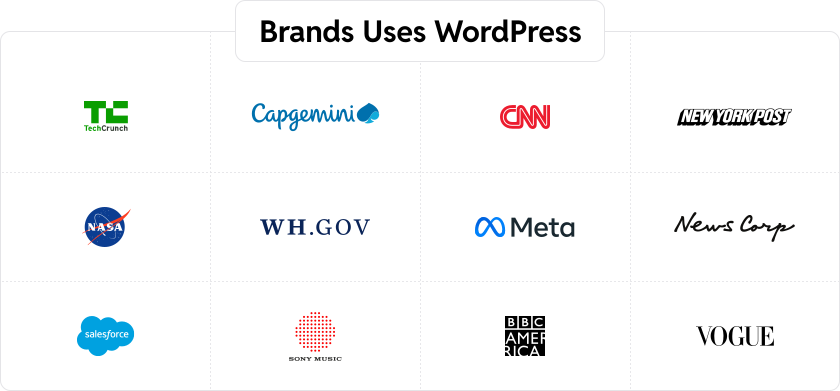
WordPress VIP is the leading provider of enterprise WordPress. With 50-60% share of a global CMS market, WordPress powers more than 34% of the Internet and is the most popular CMS in the world. WordPress VIP provides a fully managed WordPress cloud platform for unparalleled scale, security, performance, and flexibility; as well as end-to-end guidance and hands-on support. Some of their enterprise clients include major brands like TED, CNN, Spotify, Capgemini, TechCrunch, Facebook, Microsoft and many more.
Multidots is a global Enterprise WordPress digital agency headquartered in India and operating as Multidots Inc with Sales & Support offices in Virginia and California, USA. With 110+ global and distributed team Multidots has prominent presence and clients in North America, Asia, and Europe. Multidots is one of the market leaders helping content marketing, performance marketing, lead generation and publishing companies like QuinStreet, ABUV Media, Higher Educations and All Star Directories with their digital strategy and content publishing needs. Enterprise Brands and Global Corporate Groups like Accenture, Jumeirah, NAB, and SneakerNews trust Multidots for their complex and large scale WordPress implementation and multi-platform integration.
Multidots helped ABUV Media to grow from annual revenue of $100K to almost $15M and startup to a successful acquisition. Their technical expertise in the areas of WordPress, Page Performance and Security have been the key to the success of our websites. Their selection to this highly exclusive and reputed WordPress VIP featured partner program boosted my trust and confidence in their talent and team. My best wishes to Anil, Aslam, and Multidots team for this remarkable achievement.


Unlike many similar programs in the technology business, the WordPress VIP Featured Agency Partner program is kept deliberately small and highly selective. With the fact that this program was launched 9 years ago, they have still maintained only a handful of agencies as featured partners. It shows the commitment of selecting the partners proven themselves as true experts handling enterprise scale WordPress projects. After working closely with an agency on a VIP project they look for if your code is of consistently high quality, and if you engage positively with them and the client and based on that they may choose to invite you to become a Partner. And they also factor your involvement and contribution in the WordPress community. Other key criteria include clear product understanding and innovative go-to-market strategies.
In the course of 10 years, Multidots has achieved many milestones and success but Multidots making into the VIP’s featured agency partner is the biggest among all. Looking at the fact that there are approx 100,000+ WordPress Agencies in the world and 15,000+ agencies in India alone, Multidots being one of the two VIP agency partners in Asia is the moment of pride and honor for everyone at Multidots. But we also see this as a great opportunity and responsibility to work hard on improving the bad image of India as a country delivering the cheap and low-quality services.
I would humbly and gracefully dedicate this achievement to our wonderful Dots (employees of Multidots) for their massive and meaningful contribution in the WordPress Community. Since the last three years, our 20 Dots contributed to WordPress core 12 times, 10 Dots contributed in WooCommerce 7 times, played a key role to manage 32 meetups at Ahmedabad WordPress Meetup Group, Sponsored the dozens of WordCamps around the World, organized the first ever WordCamp in Ahmedabad and speaking at local and global WordCamps and WordPress Events.

As a long-time member of the growing WordPress community, we’re thrilled to be featured in this unique partnership program with WordPress VIP. With our participation in the VIP Featured Agency Partner program, our WordPress development services come with the extra benefits of the added security, flexibility and performance that most of our high-volume and enterprise projects demand. We are very grateful and thankful to our existing clients for trusting us in solving some unique problems and motivating us. And we are thrilled and pumped up to continue on our mission – “Serving People & Solving Problems”.
References
Umbraco vs WordPress: Which CMS is Right for Your Business?
Choosing the right content management system is one of the most consequential technology decisions a business can make. The CMS you select shapes how your team creates content, how developers build and maintain the site, and how much you spend over time. For organizations already invested in the Microsoft ecosystem, or those evaluating alternatives, the Umbraco vs WordPress comparison comes up frequently.
Both platforms are open-source, both are mature, and both power millions of websites worldwide. But they serve very different audiences and operate on fundamentally different technology stacks. Umbraco is built on Microsoft’s .NET framework and appeals to enterprises with existing Microsoft infrastructure. WordPress runs on PHP and MySQL, powering over 43% of all websites on the internet with a massive global ecosystem of developers, themes, and plugins.
This guide breaks down every meaningful difference between Umbraco and WordPress, from ease of use and total cost of ownership to security, scalability, and community support. Whether you are building a new digital platform, evaluating a migration, or simply exploring your options, this comparison will help you make the right call.

What is Umbraco?
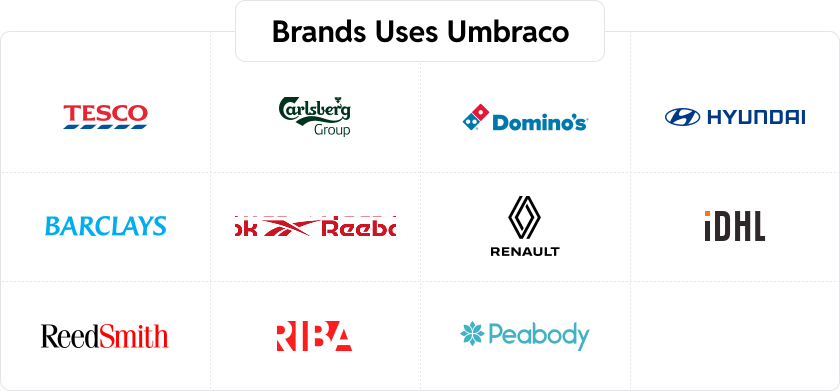
Umbraco is an open-source content management system built on Microsoft’s ASP.NET Core framework. Founded in 2004 by Danish developer Niels Hartvig, it has grown into one of the most widely deployed CMS platforms on the Microsoft technology stack. As of 2026, Umbraco powers over 750,000 websites globally and has earned recognition as a G2 Leader across CMS, Headless CMS, and DXP categories. Umbraco’s core appeal lies in its flexibility for developers and its clean editorial experience. The platform gives development teams full control over content modeling, templates, and integrations without imposing rigid structures. Its Block Grid Editor, Rich Text Editor (powered by TipTap), and multilingual content variants provide robust content creation tools. The latest major release, Umbraco 17, runs on .NET 10 LTS, keeping the platform aligned with Microsoft’s release cadence.

What is WordPress?
WordPress is the world’s most widely used content management system, powering approximately 43% of all websites on the internet. Originally launched in 2003 as a blogging platform, WordPress has evolved into a full-featured CMS capable of running everything from personal blogs to complex enterprise websites, eCommerce stores, and headless content platforms. Built on PHP and MySQL, WordPress benefits from an enormous open-source ecosystem. The official WordPress.org plugin repository hosts over 60,000 free plugins, with thousands more available as premium options. This ecosystem, combined with tens of thousands of themes, means that most functionality you could need already exists as an installable extension. WordPress is also supported by a global developer community numbering in the millions, making talent acquisition significantly easier and more affordable than with niche platforms.
Umbraco vs WordPress: Understanding the Differences
At their core, Umbraco and WordPress represent two distinct philosophies in content management. Umbraco is a developer-first CMS. It provides a blank canvas where .NET developers build exactly the experience they need, with full control over content models, templates, and data architecture. This makes it powerful in the hands of experienced development teams, but it also means Umbraco requires more upfront development investment before a site goes live.
WordPress, on the other hand, follows a more democratized approach. Its mission has always been to make publishing accessible to everyone. Out of the box, WordPress provides a functional website with a visual editor, a theme system, and a plugin architecture that let non-technical users accomplish a great deal without writing code. For developers, WordPress offers deep extensibility through hooks, filters, custom post types, and a robust API layer.
The table below provides a high-level comparison of the two platforms:
| Feature | Umbraco | WordPress |
|---|---|---|
| Technology Stack | ASP.NET Core (.NET 10) | PHP, MySQL/MariaDB |
| License | Open Source (MIT) | Open Source (GPLv2) |
| Market Share (all websites) | ~0.1% | ~43% |
| First Release | 2004 | 2003 |
| Latest Version (2026) | Umbraco 17 (.NET 10 LTS) | WordPress 6.x |
| Plugin/Package Ecosystem | Hundreds of packages (Umbraco Marketplace) | 60,000+ free plugins (WordPress.org) |
| Hosting Requirements | Windows/IIS or Linux with .NET runtime | Nearly any web host (PHP + MySQL) |
| Managed Cloud Hosting | Umbraco Cloud (from $55/mo) | WordPress VIP, Pantheon, WP Engine, etc. |
| Headless Capabilities | Content Delivery API, Management API, GraphQL (Compose) | REST API, WPGraphQL |
| Multilingual Support | Built-in content variants | Via plugins (WPML, Polylang, TranslatePress) |
| Ideal For | .NET enterprises, Microsoft-stack organizations | Businesses of all sizes, publishers, eCommerce |
Umbraco vs WordPress: Full Comparison
1. Ease of Use and Setup Process
Umbraco’s setup process is geared toward developers. Installing Umbraco requires a .NET development environment, and the initial setup involves configuring the application through the command line or Visual Studio. Once installed, the backoffice (Umbraco’s admin panel) is clean and intuitive for editors. Content types must be defined by developers before editors can start creating content, which means there is always a development phase before the platform is ready for editorial use.
WordPress is significantly easier to get started with. The famous “5-minute install” is not an exaggeration. Most hosting providers offer one-click WordPress installation, and within minutes, you have a working website with a visual editor, a default theme, and the ability to install plugins. Non-technical users can set up a WordPress site, choose a theme, and start publishing content without any developer involvement. For more complex enterprise builds, a development team is still recommended, but the barrier to entry is fundamentally lower.
For content editors, both platforms offer capable editing experiences. Umbraco’s backoffice is well-designed and uncluttered, while WordPress’s block editor (Gutenberg) provides a visual, drag-and-drop content creation experience. However, WordPress benefits from a wider range of third-party page builders and editorial workflow plugins.
Verdict: WordPress wins on ease of use and setup. Umbraco offers a polished editorial experience once configured, but requires developer involvement from day one.
2. Customization and Flexibility
Umbraco excels in customization for teams with .NET expertise. Its content modeling system is among the most flexible in the CMS space, enabling developers to create complex document types, nested content structures, and custom property editors. The platform imposes minimal opinions on your front-end architecture, meaning developers have complete freedom over markup, styling, and JavaScript frameworks. For organizations that need a highly tailored content architecture, Umbraco delivers.
WordPress offers customization at multiple levels. Theme developers can build fully custom front ends, the block editor can be extended with custom blocks, and the plugin architecture enables adding virtually any functionality. WordPress also supports custom post types, taxonomies, custom fields (via plugins like ACF or native meta fields), and REST API endpoints. The ecosystem of pre-built themes and plugins means many customization needs can be met without writing any custom code.
Where Umbraco has an edge is in structured content modeling for complex data architectures, particularly in scenarios that require deeply nested, multi-variant content. Where WordPress has an edge is in speed of customization, thanks to its massive ecosystem of ready-made solutions and the availability of developers who know the platform.
Verdict: Tie. Umbraco offers deeper content modeling flexibility for .NET teams, while WordPress provides faster customization with a broader ecosystem of pre-built solutions.
3. Content Management and Editorial Experience
Umbraco’s editorial experience is focused and deliberate. The backoffice interface presents content in a tree structure that mirrors the site’s information architecture. Editors work within structured content types defined by developers, which enforces consistency across the site. The Block Grid Editor allows for flexible page layouts, and the TipTap-powered Rich Text Editor provides a modern writing experience. Multilingual content management is built in, with block-level variants allowing granular translation control.
WordPress has invested heavily in its editorial experience through the block editor. Gutenberg provides a visual, modular approach to content creation, allowing editors to compose pages using blocks for text, images, videos, tables, and custom components. Full Site Editing extends this to headers, footers, and templates. For collaborative editing, plugins like Multicollab bring Google Docs-style inline commenting directly into the WordPress editor.
Both platforms support content scheduling, revision history, and role-based access. WordPress benefits from a wider selection of editorial workflow plugins, including advanced publishing workflows, content approval chains, and multi-author management tools.
Verdict: WordPress has the edge here, especially for organizations that value visual editing, collaborative workflows, and the ability to extend the editorial experience through plugins.
4. Plugins, Extensions, and Integrations
This is one of the starkest differences between the two platforms. The Umbraco Marketplace offers hundreds of community and commercial packages. These cover common needs like forms, SEO tools, media management, and search, but the selection is a fraction of what WordPress offers. For anything beyond the available packages, custom .NET development is required.
WordPress’s plugin repository hosts over 60,000 free plugins, with thousands more available commercially. From SEO (Yoast, Rank Math) and security (Wordfence, Sucuri) to eCommerce (WooCommerce), membership systems, learning management, and marketing automation, there is a WordPress plugin for nearly every use case. This ecosystem reduces development costs and accelerates time-to-launch.
For enterprise integrations, both platforms can connect to CRMs, marketing automation tools, analytics platforms, and third-party APIs. Umbraco’s advantage is its tighter integration with Microsoft ecosystem tools such as Azure, Dynamics 365, and Active Directory. WordPress integrates readily with virtually any third-party service through plugins, Zapier, and its REST API.
Verdict: WordPress wins decisively. The sheer scale of its plugin ecosystem is unmatched by any CMS in the market.
5. Security Features
Umbraco benefits from running on the .NET framework, which has a strong security track record. The platform has a smaller market share, making it a less common target for automated attacks. Umbraco Cloud includes built-in security features like automatic HTTPS, managed updates, and isolated environments. The platform supports granular user permissions and integrates with Active Directory and Azure AD for enterprise authentication.
WordPress’s popularity makes it a frequent target for attacks, but this does not mean it is inherently insecure. WordPress core is well-maintained with regular security patches, and the platform has a dedicated security team. The real risk with WordPress comes from outdated plugins, themes, or poor hosting configurations. When properly maintained, with reputable hosting, a Web Application Firewall, and security hardening best practices, WordPress is secure enough for enterprise deployment. Platforms like WordPress VIP enforce strict security protocols at the infrastructure level.
The key distinction is that Umbraco’s smaller ecosystem means fewer third-party code dependencies and a smaller attack surface by default. WordPress’s larger ecosystem requires more diligent management of plugin updates and security monitoring.
Verdict: Umbraco has a slight edge due to .NET’s security framework and a smaller attack surface. WordPress is equally secure when properly maintained, but requires more active security management.
6. Performance and Scalability
Umbraco, running on ASP.NET Core, benefits from the performance characteristics of the .NET runtime, which is generally faster than PHP for compute-heavy operations. Umbraco Cloud offers scalable hosting tiers, and the platform can be deployed on Azure with auto-scaling capabilities. For high-traffic enterprise sites, Umbraco’s performance is solid, particularly when backed by proper caching, CDN configuration, and optimized .NET hosting.
WordPress performance depends heavily on hosting, caching, and optimization. On basic shared hosting, WordPress can be slow. On enterprise-grade hosting platforms like WordPress VIP, Pantheon, or properly configured cloud infrastructure, WordPress handles millions of page views with ease. WordPress also benefits from mature caching solutions (both server-side and plugin-based), CDN integration, image optimization tools, and performance optimization services that have been refined over more than two decades.
Both platforms support headless architecture for decoupled front-end delivery. Umbraco offers a built-in Content Delivery API and has introduced Compose for GraphQL support. WordPress supports headless deployments through its REST API and WPGraphQL plugin, a pattern increasingly adopted by enterprise teams.
Verdict: Umbraco has a technical edge in raw server-side performance thanks to .NET. WordPress matches it at the enterprise level with proper hosting and optimization, and benefits from a more mature caching and CDN ecosystem.
7. Ownership Costs and Total Cost of Ownership
Cost is where the Umbraco vs WordPress comparison becomes most consequential for businesses. While both platforms are open-source and free to download, the total cost of ownership differs significantly.
| Cost Category | Umbraco | WordPress |
|---|---|---|
| CMS License | Free (open source) | Free (open source) |
| Managed Cloud Hosting | $55 – $900+/mo (Umbraco Cloud) | $25 – $5,000+/mo (varies by provider) |
| Developer Hourly Rate (US) | $90 – $160/hr (.NET developers) | $50 – $115/hr (WordPress developers) |
| Available Talent Pool | Smaller (.NET/Umbraco specialists) | Very large (millions of WordPress developers) |
| Theme/Template Cost | Custom development required | Free – $200 (thousands available) |
| Plugin/Extension Cost | Limited free options, often custom dev | Many free plugins, premium $0 – $500/yr |
| Typical Small Business Site | $15,000 – $50,000+ | $3,000 – $15,000 |
| Typical Enterprise Site | $50,000 – $250,000+ | $25,000 – $150,000+ |
| Ongoing Maintenance (Annual) | $10,000 – $40,000+ | $5,000 – $25,000+ |
The cost advantage of WordPress compounds over time. A larger developer talent pool means competitive rates and less vendor lock-in. The plugin ecosystem reduces custom development needs. And the availability of pre-built themes and starter templates accelerates initial development.
Umbraco’s costs are driven primarily by the need for .NET developers, who command higher hourly rates than WordPress developers, and by the smaller pool of Umbraco-specific talent. Every feature that would be a simple plugin installed in WordPress may require custom development in Umbraco.
Verdict: WordPress offers a significantly lower total cost of ownership for most organizations. Umbraco can be cost-effective for teams that already have in-house .NET expertise and Microsoft infrastructure.
8. SEO and Marketing Capabilities
Umbraco provides a solid foundation for SEO. Developers have full control over URL structures, metadata, schema markup, and page speed optimization. However, most SEO tooling in Umbraco must be built custom or sourced from a limited selection of marketplace packages. There are SEO packages available, but they are not as feature-rich or numerous as WordPress options.
WordPress is the strongest CMS for SEO out of the box. Plugins like Yoast SEO and Rank Math provide comprehensive SEO management, including real-time content analysis, XML sitemap generation, schema markup, Open Graph tags, redirect management, and more. WordPress’s clean permalink structure, native support for heading hierarchy, image alt text, and responsive design make it inherently SEO-friendly. For teams focused on SEO and organic visibility, WordPress provides more tools with less custom development.
On the marketing side, WordPress integrates easily with Google Analytics, Google Tag Manager, marketing automation platforms, email marketing tools, and A/B testing solutions. Umbraco can integrate with all of these as well, but typically requires more developer involvement to set up and maintain the integrations.
Verdict: WordPress wins. Its SEO plugin ecosystem is unmatched, and marketing integrations are available as installable plugins rather than custom development projects.
9. Support and Community
Umbraco has a dedicated and passionate community, particularly in Europe. The Umbraco community includes regular meetups, the annual Codegarden conference, and active forums. Umbraco HQ provides commercial support through Umbraco Cloud plans and offers dedicated support for enterprise customers. However, the community is smaller, and finding answers to specific questions can take longer. The talent pool of Umbraco developers is concentrated in Western Europe.
WordPress has the largest CMS community in the world. With tens of thousands of blog posts, tutorials, Stack Overflow answers, YouTube videos, and dedicated forums, almost any WordPress question has already been answered somewhere. WordCamp conferences happen across the globe, and local meetups run in hundreds of cities. The WordPress developer talent pool spans every continent, and agencies specializing in WordPress development are abundant. For enterprise support, WordPress VIP and specialized agencies like Multidots provide dedicated assistance.
Verdict: WordPress wins. The scale of its community, documentation, and available talent is unmatched.
Umbraco vs WordPress: Which CMS is Right for Your Business?
The right choice depends on your organization’s technology stack, team composition, budget, and long-term goals. Here is a practical breakdown.
Choose Umbraco if:
- Your organization is deeply invested in the Microsoft ecosystem (Azure, .NET, Active Directory, Dynamics 365)
- You have an in-house .NET development team or a trusted Umbraco agency partner
- You need highly structured, complex content modeling that goes beyond typical CMS patterns
- Your compliance requirements mandate staying within a Microsoft-only stack
- You are building a digital experience platform tightly integrated with other Microsoft products
Choose WordPress if:
- You want a faster time to launch with lower upfront costs
- Your team includes non-technical content editors who need to work independently
- You need access to a large ecosystem of plugins, themes, and integrations
- You want a wide talent pool and competitive developer rates
- You plan to scale with eCommerce (WooCommerce), membership, or publishing workflows
- You want flexibility to go headless or stay traditional
- Budget efficiency and total cost of ownership are important decision factors
For most businesses, WordPress is the more practical, cost-effective, and versatile choice. Umbraco serves a specific niche well, but the advantages of WordPress’s ecosystem, talent pool, and lower total cost of ownership make it the stronger option for the majority of use cases.
Why Companies Migrate from Umbraco to WordPress?
The migration from Umbraco to WordPress is a pattern Multidots sees regularly, driven by several recurring factors.
1. Umbraco 8 End of Life. Umbraco 8 reached end of life on February 24, 2025, meaning no further security patches or updates. Organizations still running Umbraco 8 face a choice: upgrade to Umbraco 13+ (which requires a near-complete rebuild due to the shift from .NET Framework to .NET Core), or migrate to a different CMS entirely. Many find that if they need to rebuild anyway, switching to WordPress offers a better long-term return.
2. Wider talent pool and lower costs. Finding .NET developers with Umbraco experience is challenging and expensive, particularly outside Western Europe. WordPress developers are available globally at competitive rates, reducing both project costs and ongoing maintenance expenses.
3. Plugin ecosystem advantages. Features that require custom .NET development in Umbraco often exist as mature, well-supported WordPress plugins. This dramatically reduces the cost and timeline for adding new capabilities.
4. Better marketing and SEO tooling. Marketing teams consistently find that WordPress provides more powerful, easier-to-use tools for SEO, analytics, and campaign management without requiring developer involvement for every change.
5. Scalability without lock-in. WordPress runs on virtually any hosting infrastructure, from shared hosting to enterprise-grade platforms like WordPress VIP. This flexibility prevents vendor lock-in and gives organizations more control over their hosting costs and architecture.
If you are considering a migration, we have published a comprehensive Umbraco to WordPress migration checklist and a detailed guide covering the step-by-step migration process. For teams evaluating their approach, our comparison of automated vs manual migration methods can help you choose the right path.
How Multidots Can Help?
Multidots is a WordPress VIP Gold Partner with 16+ years of experience in enterprise WordPress development and over 300 successful website migrations. We specialize in helping organizations migrate to WordPress from platforms like Umbraco, AEM, Drupal, and others.
Our migration process is thorough and low-risk. We handle content migration, URL mapping and redirect strategies, custom theme development, plugin selection, performance optimization, and post-launch support. Every migration is planned to minimize downtime and preserve your SEO equity.
Beyond migration, we offer ongoing enterprise WordPress development, performance optimization, and SEO services to ensure your WordPress site delivers results long after launch. You can explore our track record through our case studies.
Ready to explore whether WordPress is the right move for your organization? Get in touch with our team for a free consultation and migration assessment.
Understanding Sanity Web Development and the Future of Headless CMS
Key Takeaways
- Model content as structured data so you can update once and publish everywhere without duplication.
- Send production traffic through Sanity’s CDN, not the Live API, to keep usage-based costs predictable.
- Invest upfront in clean content models and tight GROQ queries to avoid developer bottlenecks later.
- Configure Studio around real workflows – roles, approvals, validation – so editors move fast without breaking structure.
- Plan migrations with zero-downtime sync and structured data cleanup, or you’ll pay for legacy shortcuts twice.
Your team drafts a product announcement. Then rewrites it for the website. Reformats it for the mobile app. Tweaks it again for email. Three versions, three rounds of edits, triple the effort. By launch day, you’re juggling version control, chasing last-minute changes, and wondering why “go live” feels more like “hold everything.”
The issue is traditional platforms were built for a world where “the website” was the main event. Whereas now your business spans web, mobile, email, digital signage, voice assistants, and whatever channel will launch next quarter. Duplicating content for every channel simply doesn’t scale. It’s slow, expensive, and full of opportunities for things to go slightly (or wildly) wrong.
With Sanity, instead of locking content into page templates for specific screens, everything is stored as structured, reusable data. You write the product announcement once – headline, description, specs, images – and that single source flows wherever it’s needed.
In practice, your website pulls structured content via APIs, mobile apps request the same data for smaller screens, while email platforms extract what they need for campaigns. Any new channels just connect to the same content pool without forcing you to rebuild from scratch.
The end result is you get to create once and publish everywhere. Fewer formatting marathons. Far less launch-day chaos. Just structured content that’s ready for whatever comes next.
What Sanity Is and Why It’s Different
Sanity is a headless CMS that stores content as structured data in a central Content Lake, enabling teams to deliver it across multiple channels and frontends.
Content as Reusable Data
Instead of tying content to a single design, Sanity treats products, articles, and author profiles as independent data objects, allowing each one to be referenced across every digital property you run.
Write a product description once – headline, features, pricing, images defined as fields – and that same source can power your website, mobile app, email campaigns, and whatever channel comes next. Update the price in one field, and it updates everywhere, removing the need to republish across half a dozen systems and eliminating the risk of duplication entirely.
Sanity’s Architecture
Sanity runs on two separate systems.
The Content Lake (hosted by Sanity) stores your structured data.
Studio (a React app you deploy) is the editing interface your team uses.
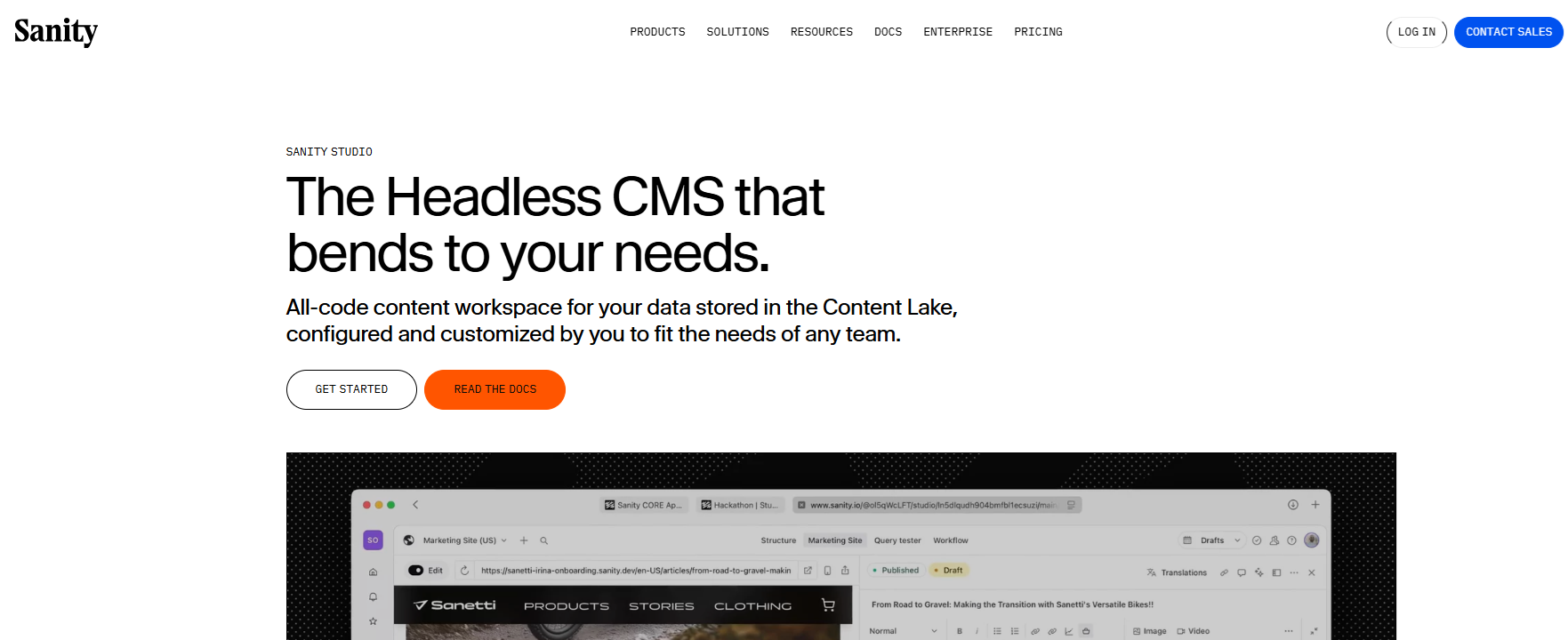
Sanity web development with Sanity Studio
You pay Sanity for Content Lake services – storage, API requests, bandwidth, and editor seats.If you choose to self-host Sanity Studio, you would also pay Vercel, Netlify, or another provider to host it – but this is entirely optional. Studio can be hosted for free using Sanity’s managed hosting, so separate hosting costs aren’t mandatory.
API-Based Content Delivery
When someone visits your site, your frontend requests the specific content it needs from the Content Lake. Sanity returns clean JSON via API, and your application renders it appropriately.
That same product data can power your marketing site, mobile app, and in-store kiosks simultaneously. You simply update it once in Studio, and it propagates everywhere automatically.
It’s the ultimate future-proof solution. As you expand – voice integrations, AR experiences, new digital properties – you don’t migrate content. You just connect whatever is next to the existing API.
How Sanity Differs from Traditional CMS
Traditional platforms like WordPress bundle content and presentation together in one monolithic system. The same software handles what you create, how it looks, and the URLs users land on, keeping content and presentation tightly intertwined.
Sanity separates those concerns entirely, storing content as structured data in the Content Lake while your React site, Vue app, or Next.js frontend each pulls from that same source and renders it in their own way.
The payoff is long-term stability. You can redesign your site every couple of years, swap out frontend frameworks, or evolve your tech stack without having to rebuild or untangle your content each time.
Understanding Sanity’s Dual-Billing Structure
Sanity’s pricing has two moving parts. First, you pay for Content Lake services – storage, API requests, bandwidth, and editor seats. The free tier covers 20 seats, two public datasets, and unlimited content types, which is plenty for personal projects. Growth plans start at $15 per seat per month (up to 50 seats) plus usage-based costs, while Enterprise plans move to custom pricing and layer in SLAs, SAML SSO, audit trails, and dedicated support.
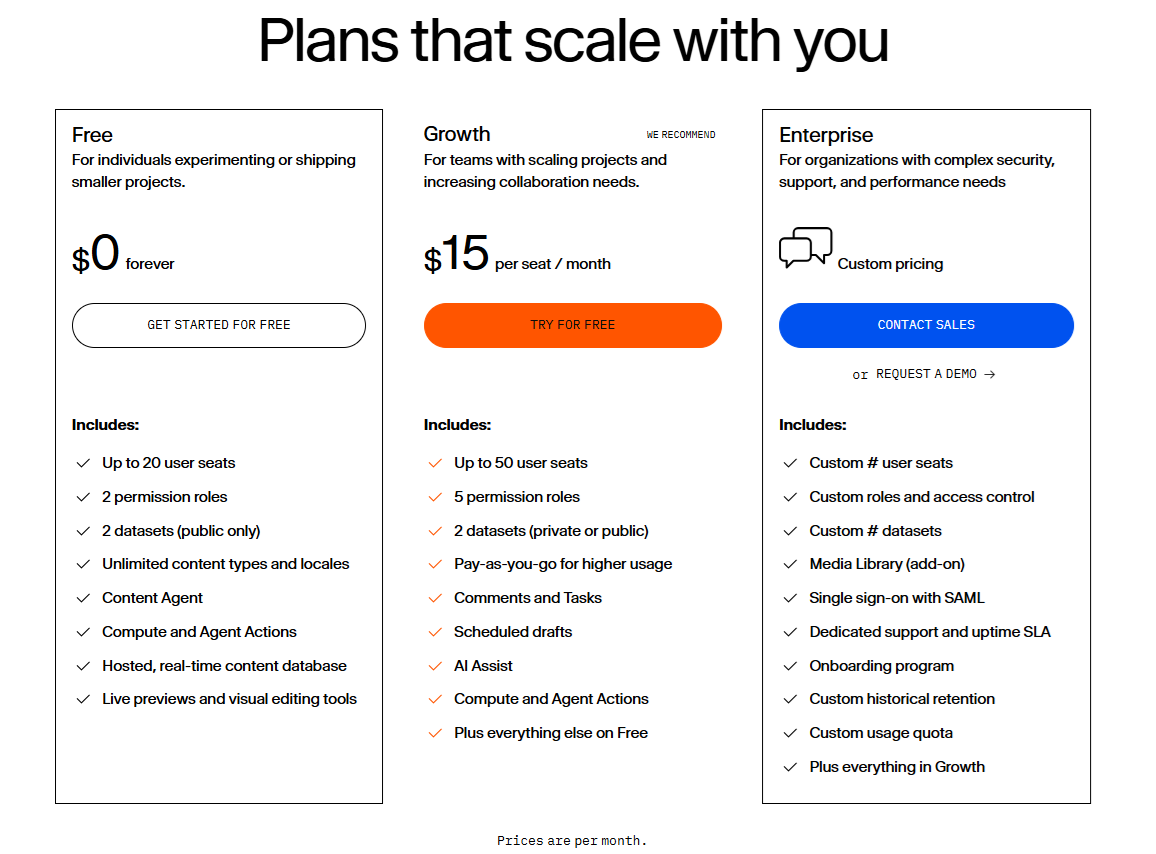
Pricing options for Sanity web development
Studio hosting sits separately. You can deploy to yourname.sanity.studio with a single command for free, or self-host via Vercel, Netlify, or your own infrastructure. Most teams opt for Vercel or Netlify, which typically adds $20–200 per month, depending on traffic.
Total cost of ownership is discussed at the platform level but ignores developer time costs – GROQ learning curves, content modeling, and custom Studio configuration are real budget line items for prospects evaluating Sanity vs WordPress.
Because costs scale with API usage, request monitoring isn’t optional. Routing traffic through Sanity’s CDN endpoint – rather than the Live API – keeps spending predictable, so don’t overlook this. It’s best not to discover the pricing mechanics after the invoice arrives.
How Sanity Works for Your Organization
Centralized Content Storage
Imagine every piece of content in one place, rather than scattered across marketing drives, engineering repos, or fossilized in SharePoint. Just a single, managed database your team accesses through the editing interface: the Content Lake. Versioned. Searchable. Available to every digital property.
Content is structured around models that reflect how your business actually operates. Product models include SKU, title, description, specs, pricing, and images. Article models define headline, body, author, publish date, and SEO metadata. Those models enforce consistency, so checkout always gets the fields it expects, and SEO tools always have the metadata they require.
Rich content lives in Portable Text, which renders cleanly across desktop, mobile, and voice assistants when developers configure and build the appropriate renderers for each frontend. Portable Text provides the structured content format, but how it displays is defined in code. Whereas traditional HTML can splinter across platforms, Portable Text adapts.
The outcome is no silos and no version-control roulette. Marketing can’t publish outdated pricing because there’s one source of truth. Your mobile app can’t pull the wrong description because everything syncs from the same place.
Customizable Editing Experience
Developers shape the editing interface around real workflows. Junior editors draft, senior editors approve. Slugs auto-generate from headlines. Conditional fields appear by content type. It’s all configurable.
Content models are defined as code – JavaScript files under version control, alongside the rest of your software. You can test before deployment, roll back if needed, and track exactly who changed what.
Field layouts, validation rules, previews – you decide how they work. Simply add custom inputs when plain text isn’t enough. The system will adjust to your team’s processes.
Efficient Content Retrieval
Sanity runs on GROQ, a query language designed to fetch precisely what each platform needs. A single query can return a blog post with its author, or a product with its category and related items, rather than the surrounding catalogue of content. That means fewer round-trips than traditional REST APIs, less data transfer, and much faster load times.
But there is a learning curve. GROQ is proprietary and differs from SQL. Although GraphQL is available, it’s less powerful for projecting and transforming content during retrieval, which is why most teams invest in GROQ training to unlock the full advantage.
From Editor to Delivery
Editors work inside the customized Studio interface and see only what’s relevant to their role, allowing product managers access to different content types than blog editors.
Once content is saved, it lands in the Content Lake and becomes instantly available everywhere, with updates syncing in real time. As soon as changes are published (rather than left in draft), they’re immediately queryable via Sanity’s APIs and can be fetched by any connected frontend. Exactly when those updates appear to end users then depends on your delivery setup – for example, whether you’re using static site generation, incremental static regeneration, or a fully dynamic frontend – but the source of truth is updated the moment you hit publish.
Each channel then queries what it needs – the homepage pulls featured products, the mobile app requests purchase data, and the email platform retrieves campaign copy. Same source. Purpose-built output.
Because editing, storage, and delivery are decoupled, each layer scales independently. You can expand your editorial team from five to fifty without reworking infrastructure, absorb traffic spikes without slowing content operations, and launch new digital properties without migrating content or rebuilding backends.
Webhooks and event-driven architecture
Sanity’s webhook system is a meaningful capability for triggering rebuilds or syncing downstream systems, and it’s absent despite the document covering content delivery in detail.
Why Organizations Choose Sanity
Publish Once, Distribute Everywhere
Managing content across channels can feel like plate-spinning: update it here, tweak it there, fix it again somewhere else. With Sanity, you get to cut out the scavenger hunts when you spot a typo or need to change a price. Once you make the change at source, you don’t have to worry about outdated copy hiding in forgotten corners.
The payoff is speed and sanity (pun intended), with teams regularly reporting cutting publication time in half after replacing manual multi-channel workflows with Sanity’s unified model.
Real-Time Editorial Collaboration
No more waiting for someone to “unlock” a page. Multiple editors can work simultaneously, with live cursors and field highlights showing exactly who’s editing what. Sanity’s real-time listener API (for live previews and collaborative editing) is never explained, even though real-time collaboration is listed as a selling point. Less duplication. Fewer crossed wires.
Version history means instant rollbacks if something goes sideways. Granular permissions keep control tight and workflows smooth – junior editors draft, managers approve, marketing updates campaigns without touching product specs. Everyone moves faster, with guardrails intact.
And it doesn’t stop at workflow. Sanity has been steadily layering AI into the editing experience itself. Through Sanity AI Assist, teams can generate summaries, rewrite or translate content, extract structured data, and even auto-tag entries directly within the Studio. Because it operates on your structured content model, the output stays aligned to your schema and governance rules. In practice, that means AI can speed up production without bypassing the same permissions, version history, and approval flows that keep your content operation safe.
Protection for Your Content Investment
Although frontend trends will change, your content doesn’t have to.
Whether you’re on React today and Vue tomorrow, your content stays put in the Content Lake. You just point a new frontend to the existing API and keep moving. Redesigns don’t require migrating thousands of items or risking SEO turbulence. Content and presentation evolve independently, avoiding risky all-at-once overhauls.
When Sanity Matches Your Needs
Sanity excels when you’re managing content across multiple properties and have development resources to shape and maintain the architecture. It’s built for teams that need flexibility and control. But there are a few realities to plan for:
Pricing is usage-based (API requests, bandwidth, editor seats), so scale needs monitoring, while routing the lion’s share of traffic through the CDN rather than the Live API is an important step to keep costs in check.
Enterprise migrations typically take 12–20 weeks, covering content modelling, legacy transition, Studio customization, frontend integration, and testing. If you’re moving from platforms like Sitecore or AEM, experienced implementation partners are critical to manage complexity and safeguard SEO.
Partner with Multidots for Sanity Implementation
Implementation Expertise Drives Results
So, you’ve chosen Sanity. Excellent. Now comes the part that actually determines whether it pays off: implementation.
Sanity’s flexibility is powerful, but every architectural decision carries weight. Route content through the wrong API endpoint, and costs climb. Design an awkward content model, and developers get pulled into everyday edits. Overlook image optimization, and page speeds slow to a crawl.
Strong results demand more than platform familiarity. You need precise content architecture, disciplined migration planning, and cost control embedded from day one. Structuring a 100,000-SKU catalogue is worlds apart from modeling an editorial workflow. Knowing when to denormalize for performance, and when restraint is wiser, can spare you an expensive rebuild later.
Multidots is an official Sanity partner with 300+ enterprise platform migrations completed, spanning Sitecore, AEM, Drupal, and Contentful. We’ve architected for publishers serving 35 million monthly page views, e-commerce platforms managing 100,000+ SKUs, and global teams coordinating content across regions.
Our approach is practical: build models around how your teams actually operate. Custom approval flows, conditional publishing rules, specialized fields – all configured in Studio from the outset so editors can move without workarounds.
Zero-Downtime Migration Methodology
With Multidots, migrations don’t need to mean crossed fingers and midnight launches. Our delta synchronization method keeps Sanity updating continuously while your existing platform remains live. Content created mid-migration syncs automatically, keeping both systems aligned.
Deterministic IDs prevent duplicates if scripts restart. Legacy quirks like missing metadata, broken references, or inconsistent formatting are resolved during transfer, rather than uncovered after launch.
Our expert engineers also apply semantic modeling to transform unstructured legacy content into structured Sanity schemas ready for multi-channel reuse. HTML blobs become portable text. Product copy buried in templates becomes clean, queryable data your mobile app can use independently.
Before production cutover, staging validation gives every team visibility. Marketing reviews campaigns. Editorial checks formatting. IT verifies integrations. This way, problems can surface early when they’re still straightforward to fix.
Get Started with Sanity
You’ve got plenty of reasons for eyeing Sanity – multi-channel content, serious flexibility, big ambitions. But naturally, a few practical questions will follow.
Will your architecture keep API costs predictable, or quietly inflate them? Will editors move at the pace, or rely on developers for every change? And will your content models scale smoothly, or need expensive refactoring down the line?
Sanity delivers on its promise. It powers everything from focused marketing sites to complex enterprise publishing ecosystems. But the outcome hinges on the decisions you make early. Architecture and migration planning determine whether that flexibility becomes a competitive edge or an operational drag.
The difference between promise and performance is implementation expertise and proven migration methodology. First-time teams often run into familiar issues: content models that bottleneck daily workflows, API usage that becomes costly at scale, or migrations that compromise metadata and content relationships.
Experienced implementation partners remove that risk. You get architecture aligned to real editorial workflows, API routing designed for cost efficiency from day one, and a migration approach refined across hundreds of enterprise transitions.
So, if you’re ready to explore Sanity for your organization, contact Multidots for a migration assessment and implementation roadmap. We’ll review your current platform, map your content architecture requirements, and define a realistic timeline and budget for transitioning to Sanity’s multi-channel content operating system.
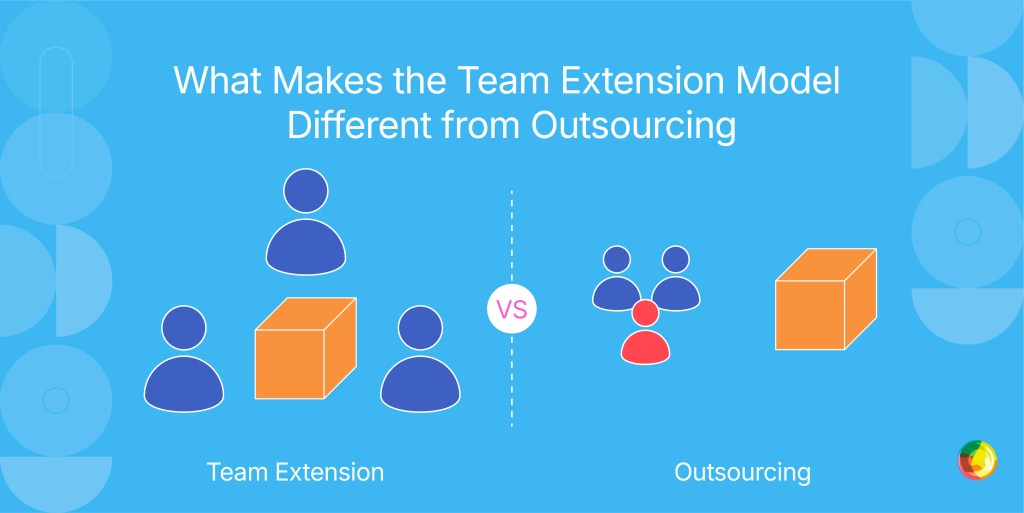
What Makes the Team Extension Model Different from Outsourcing
Key Takeaways
- Don’t bring in extended developers until your own processes are solid; distributed teams don’t fix messy workflows, they amplify them.
- Treat overlap hours like gold: 3–4 shared hours with clear decision rights will save you days of async back-and-forth and stalled progress.
- Build slack into capacity on purpose – when extended teams are run flat out, the first casualties are documentation and knowledge transfer, and you’ll feel that debt later.
- Lock in people rather than scope: flexible resourcing with clear ownership lets you adapt as priorities shift without renegotiating your entire contract every sprint.
So, you’re bringing in extra developers. Simple, right? Not quite. The model you choose quietly dictates who’s in charge, how work actually gets done, and what you’re left with once the sprint dust settles.
With team extension, external developers plug directly into your team. They use your tools, follow your processes, and work inside your workflows while you manage their output day to day. Outsourcing, on the other hand, hands delivery over to a vendor who owns the methods and most daily decisions. That difference in control shapes everything that follows: how quickly features ship, where knowledge lives, and whether you’re building internal capability or temporarily borrowing it.
If you’re a tech lead weighing up how to add capacity or niche expertise without losing control of delivery, budget, or technical ownership, this guide breaks down what team extension really means (also known as staff augmentation or extended teams), how it compares to outsourcing and dedicated team setups, and when each model actually makes sense for your situation.
You’ll come away clear on:
- Operational distinctions between team extension, outsourcing, and dedicated teams.
- Day-to-day workflow realities when external developers join your sprints.
- Integration best practices that prevent coordination chaos.
- Fit scenarios showing which model solves your specific constraints.
- Common challenges teams hit when scaling with external capacity.
- Cost frameworks that go beyond hourly rates to reveal the true economics.
What Team Extension Means
So, let’s imagine a developer joins your daily standups, pushes code to your repos, sticks to your coding standards, and takes direction from your engineering lead. They’re not on payroll, but day to day, they’re embedded like they are. That’s team extension.
Here’s how it works in practice:
- They’re in your sprints, planning sessions, code reviews, and retrospectives.
- They work inside your GitHub, Jira, Slack, and dev environments.
- They follow your docs, testing standards, and deployment processes.
- Your technical leads assign tasks, set priorities, and review output.
- Feedback runs through your existing management structure.
What Team Extension is NOT:
This isn’t hiring freelancers who disappear and reappear with finished features. It’s not a vendor-run team working off to the side and emailing status updates. And it’s not full-time hires with benefits and permanent contracts.
The distinction matters. With team extension, developers sit under your management, whereas a dedicated team is managed by the provider but focused on your work. Outsourcing means the vendor owns delivery end-to-end.
Most engagements run on monthly retainers or flexible hourly models, so you can scale capacity as demand shifts. We’ll dig into the economics later in the guide.
Is Team Extension the Same as Staff Augmentation?
Not quite. Staff augmentation typically means plugging individual contractors into specific roles under your direction, often short term and task-focused. Team extension, by contrast, embeds a cohesive group (or long-term contributors) into your workflows, rituals, and tooling, operating as a true extension of your in-house team with shared accountability and deeper strategic context. The difference isn’t just semantic – it’s about integration, continuity, and ownership.
How Control and Accountability Differ Across Models
So let’s clear the fog. The real question is who’s actually running the work day to day. With team extension, you’re in the driver’s seat: you assign tasks, set priorities, and review output directly.
With outsourcing, the vendor owns delivery and makes most tactical calls within the agreed scope. Dedicated teams sit in the middle: the provider’s project manager runs daily operations, while you steer the strategy.
Here’s how that plays out in practice:
| Decision Area | Team Extension | Dedicated Team | Outsourcing |
|---|---|---|---|
| Work assignment | Your leads assign | Provider’s PM assigns | Vendor manages internally |
| Sprint planning | Your PM runs it | Provider’s PM facilitates | Vendor handles independently |
| Architecture calls | Your architects decide | Provider’s tech lead proposes | Vendor designs and presents |
| Code access | Your repo, day one | Your repo, provider manages commits | Vendor-controlled repo, shared on agreed terms |
| Delivery cadence | Continuous integration into your sprint rhythm | Agreed sprint cycles with regular releases | Delivery at milestones or phase sign-off |
The trade-offs matter. Team extension builds deep partnership – faster decisions, continuity, and developers who really understand your technical debt and architectural choices. The downside? Switching costs if priorities change. Outsourcing keeps operational distance, making vendor swaps cleaner, but you give up that embedded expertise and institutional memory.
A reality that often gets glossed over is just how much handoffs and time zone gaps can slow everything down. To transition well, you need to define overlap windows and ownership with precision. A developer in Bangalore can’t unblock themselves if architectural calls need your CTO, and your CTO is asleep.
Control also drives integration overhead. Team extension means bringing external developers into roadmap discussions, architecture reviews, and technical strategy. Dedicated teams and outsourcing absorb more coordination internally, which lowers your management load but also your influence.
Contracts follow the same logic. Team extension agreements lock in resources (e.g., three senior WordPress developers) while keeping scope flexible. Outsourcing contracts lock in outcomes (e.g., migration complete by Q2), tightly bounding scope to manage vendor risk.
The teams that get the best out of their chosen arrangement dive deep into how team extension and outsourcing differ operationally.
How Team Extension Works Day-to-Day
So, what does this actually look like in practice? External developers plug straight into your team. They join your meetings, push code to your repos, open pull requests, and work inside your project management tools, moving at your pace and within your existing development rhythm.
A typical sprint cycle looks like this:
- Planning: Extended team members estimate story points and commit to capacity alongside internal developers.
- Standups: Updates shared during core overlap hours or via async Slack summaries.
- Development: Work happens in your repos, following your branching strategy and coding standards.
- Code review: PRs flow through your usual review process.
- Demo/retro: Completed work is presented and improvements discussed together.
Five practices that make integration work:
- Establish core overlap hours: 3–4 hours daily when everyone’s online for real-time collaboration.
- Include strategically: Bring extended developers into roadmap and architecture discussions, not just ticket delivery. Access without context creates misunderstandings, and that never ends well.
- Apply consistent standards: Same rituals and practices, same expectations.
- Document decisions: Capture the “why” in writing so knowledge isn’t trapped in meetings.
- Build in knowledge transfer: Technical docs, milestone demos, and pair programming stop expertise from staying locked in the extended team
Tool access follows least privilege: that means permissions for Git, continuous integration and continuous delivery (CI/CD) pipelines that automatically build, test, and deploy code changes, staging, and communication tools – but not production databases. Security-focused setups use VPNs and role-based controls, while regulated industries working under Zero Trust Architecture should expect 1–2 weeks for onboarding.
To deliver the best onboarding timelines and team scaling strategies for your business, you’ll need to understand the complete staff augmentation process.
When Each Model Fits Your Situation
So, which delivery model actually makes sense for your setup? It depends on how much control you want, how clear the work is, and how much day-to-day management you can realistically take on.
Team extension works when you need extra capacity or niche skills without handing over the keys. If institutional knowledge matters, workloads rise and fall, and you’ve got the bandwidth to integrate external developers into your workflows, it may be your best bet.
Choose team extension when:
- You already have solid processes that remote developers can slot into. Messy internals plus distributed teams are a fast way to multiply chaos.
- You need specialist skills (WordPress VIP, specific frameworks) for long stretches, but not long enough to justify permanent hires.
- Your workload spikes and dips – big upgrades, seasonal traffic surges, or project bursts. Flexibility beats carrying idle headcount.
- You want control over technical direction and know how to manage distributed teams well.
Outsourcing makes more sense when:
- The scope is tight, deliverables are clear, and outcomes matter more than process control.
- You don’t have the internal expertise to steer technical decisions and want the vendor to own that responsibility. If you’re after strategic input as well as execution, it’s worth exploring the differences between staff augmentation and consulting.
- Your management bandwidth is thin – you want milestone check-ins rather than daily standups and sprint planning.
Dedicated teams fit when:
- You want an autonomous unit with less hands-on involvement than extension, but more control than pure outsourcing.
- You need scale across multiple technology stacks through a single vendor relationship.
- Your internal team is lean, and you want the provider handling technical leadership.
Real-World Examples
Media publisher with volatile priorities: Ask Media Group migrated 11 sites serving 10M+ monthly visitors in just 12 weeks. Developers joined daily standups and pivoted mid-sprint as editorial needs shifted. Team extension delivered the flexibility that fixed-scope outsourcing couldn’t.
E-commerce seasonal scaling: RHR Swag scaled a WordPress platform to support 100,000+ WooCommerce SKUs during peak seasons. The extended team drove a 145% conversion boost while scaling capacity up and down with demand – something permanent hires or rigid outsourcing contracts wouldn’t allow.
The pattern? Team extension wins when flexibility and control matter. Outsourcing suits a bounded scope and defined outcomes. Dedicated teams offer autonomous scale. Many organizations mix models across different workstreams.
When team extension is not right: Immature dev processes, unclear requirements, zero experience with remote teams, or situations where the lowest cost outweighs quality and integration. In those cases, full-time hires or traditional outsourcing are usually a better fit.
WordPress-specific advantage: Specialists like Multidots cut out the 2–3 week learning curve through deep WordPress VIP expertise, reducing ramp time and execution risk on enterprise migrations and complex builds.
Common Challenges and What to Expect
So, you’ve gone distributed. Great. Now come the realities: time zones slow decisions, quality needs closer oversight, and the line between “building” and “advising” can get fuzzy, fast. Weak remote practices don’t help; they magnify every small snag. Making this work means clear rules, explicit processes, and firm boundaries.
Time zones are the first friction point. Questions that take 10 minutes in a room can drag on for days across continents. The fix is 3–4 hour overlap windows, decisions written down immediately, and clear decision rights so progress doesn’t stall waiting for approval.
Utilization matters more than it looks. When extended developers run flat out with no slack, quality slips. The first things to go are documentation, knowledge transfer, and collaboration – exactly what prevents long-term technical debt. Build in buffer time so quality and institutional knowledge don’t quietly erode.
Quality also varies by provider and by individual. Not every developer brings the same depth. Be explicit about required skill levels, and don’t be shy about requesting rotation if expectations aren’t being met.
Scope creep is almost guaranteed. Developers will surface architectural issues – that’s useful. But set the line clearly: they raise concerns, you decide what to pursue. Anything beyond implementation belongs in a separate consulting scope.
Expect more meetings, too. Distributed teams add coordination overhead. Keep attendance tight, align meetings to real decision needs, and default to async updates wherever live discussion isn’t essential.
Cultural integration needs deliberate effort from day one. Hierarchy, feedback styles, and decision authority don’t translate automatically. For offshore staff augmentation, time zones, culture, and communication protocols become mission-critical, not “nice to have.”
Finally, measure what actually matters: steady velocity, healthy utilization, pull request (PR) merge times, and, most importantly, the business outcomes the extended team was hired to improve.
Cost Structure Basics
Team extension typically runs on monthly retainers or hourly rates, and what you pay depends on developer seniority, technical specialism, and how deep the engagement goes. Provider margins cover recruiting, HR, ongoing management, and business infrastructure – the same overhead you’d otherwise be carrying in-house.
Pricing usually comes down to four things: seniority, technical specialization (WordPress VIP optimization commands a premium over generalist dev work), engagement terms (longer commitments unlock better rates), and provider positioning. Enterprise-focused firms with compliance certifications simply cost more than talent marketplaces.
Here’s what you’re not paying for: benefits packages, recruitment costs and time-to-hire, office space and equipment, downtime between projects, training programmes, or HR, legal, and management infrastructure.
Here’s what you are paying for: the provider’s recruiting and vetting, ongoing management to keep developers engaged, business continuity when individuals leave, administrative overhead, and enterprise-grade tools and infrastructure.
Team extension tends to make economic sense when:
- Workloads fluctuate, and permanent staff would sit underused.
- You need senior-level specialists, but not full-time.
- Rapid scaling matters, and hiring timelines would miss deadlines.
- You’re testing capacity before committing to permanent headcount.
If your needs are consistent over multiple years, permanent hiring often works out cheaper. That said, the ability to scale without layoffs can justify the premium. You’ll want to explore the full comparison of staff augmentation vs traditional staffing to weigh those trade-offs.
For a proper cost picture, you’ll need clarity on technical requirements, expertise levels, and compliance needs. Companies like Multidots provide estimates based on real project scope rather than industry averages.
What to Consider Before Moving Forward
Before bringing extended team members into the mix, pause for a quick readiness check to surface friction early.
Start with five simple questions:
- Process maturity: Do you have documented workflows external developers can follow, or does everything live in people’s heads?
- Management bandwidth: Can leads consistently review work, add context, and unblock issues, or are they already at capacity?
- Remote experience: Have you worked successfully with distributed teams before? If not, begin with a pilot.
- Technical clarity: Can you clearly explain your architecture and priorities?
- Security posture: In regulated environments, do you have proper onboarding and access controls in place? Budget 1–2 weeks for basic setup.
Scope and duration matter. Team extension works best for longer engagements (six months or more), where the upfront integration pays off. Short projects – under three months – are often better handled as straight outsourcing.
Then there’s the specialist vs. generalist call. Platform-specific needs, like WordPress VIP optimization, usually benefit from specialists who skip ramp-up time. Broader, multi-stack projects may suit generalists to keep coordination lighter. Match the provider to your biggest constraint.
Start small to test the waters. One or two developers, 2–3 months, clearly defined scope. It’s a low-risk way to assess communication, quality, and cultural fit before scaling up.
If you’re considering a hybrid model that blends team extension with managed services, it’s worth reviewing precisely how staff augmentation and managed services compare to see where each fits best.
If, on the other hand, you’re ready to explore next steps, speak with providers about your needs, relevant experience, and engagement approach. For enterprise-scale WordPress platforms, it’s worth talking to specialists like Multidots about technical fit and delivery models.
Make Your Team Extension Work
So, which model actually fits – team extension, outsourcing, or a dedicated team? It comes down to three things: how much control you need day to day, how much management time you can realistically give, and whether your workload justifies deeper integration.
Team extension shines when your processes are solid, you have the bandwidth to manage, and the work isn’t going away anytime soon. You steer the ship, developers slot into your workflows, and hard-won knowledge stays in-house.
Outsourcing works best when you want to stay hands-off, the scope is clear, and check-ins at key milestones beat daily involvement.
Dedicated teams suit cases where you need to scale fast without the overhead of integration, and you’re happy for the vendor to lead the technical direction on a defined initiative.
The key is to be realistic. Choose what matches how you actually operate today, not how you hope to one day. Start small, test the fit, then scale with confidence.Evaluating team extension for WordPress? Contact Multidots to discuss how our VIP expertise and enterprise migration experience align with your platform needs.
Arc XP CMS Alternative: Top 3 Enterprise CMS Alternatives to Arc XP
Key Takeaways
- Arc XP delivers strong newsroom workflows but introduces high licensing costs, vendor lock-in, and limited extensibility.
- Enterprise publishers migrate due to high total cost, restricted customization, and a very small developer ecosystem.
- WordPress provides enterprise flexibility, a massive plugin ecosystem, and 40 to 60 percent lower long-term costs.
- Sanity enables API-first, structured content architecture suited for omnichannel publishing and AI-ready content strategies.
- AEM supports complex enterprise personalization but requires significant budget, specialized developers, and long implementation timelines.
If you’re an enterprise leader evaluating your content management stack, especially with an Arc XP license renewal approaching, there’s a good chance you’ve started questioning whether the platform’s costs and limitations justify the investment.
You’re not alone.
Over the last 16 years at Multidots, we’ve talked to hundreds of enterprise teams running legacy and proprietary CMS platforms, including Arc XP. The pattern is consistent: strong editorial tooling for newsrooms, but severe constraints the moment your digital ambitions extend beyond traditional publishing.
This guide examines three enterprise-grade Arc XP alternatives: WordPress, Sanity, and Adobe Experience Manager (AEM). We’ll break down costs, features, migration complexity, and use cases based on actual enterprise implementations and over 300 migrations, not vendor marketing materials.
The goal is simple: help you make an informed decision without wasting months evaluating platforms that won’t fit your needs.
What Arc XP Offers (And Why Companies Are Looking Elsewhere)
Arc XP is a cloud-native digital experience platform built inside The Washington Post’s newsroom. It’s purpose-built for media companies and large publishers, offering a comprehensive suite that includes:
- Composer: A newsroom-optimized content authoring tool with streamlined editorial workflows
- WebSked: An editorial calendar and planning system that spans from story pitches to multi-channel syndication
- Digital Asset Management (DAM): Integrated photo and video management with transcoding, live streams, and ad integration for video monetization
- Arc Intelligence: AI-powered tools including an editorial AI assistant, automated translations, text-to-speech audio articles, and vector-based content recommendations (available as add-on packages with additional licensing)
- Page Builder: A drag-and-drop frontend management tool built on a headless architecture
- Subscription and Identity Management: Built-in tools to monetize content through paywalls and subscriber management
Arc XP supports over 2,000 sites across 25+ countries, serving publishers like Reuters, ESPN, Le Parisien, and The Washington Post itself.
But here’s what enterprise teams discover after a year or two: Arc XP’s annual licensing typically runs between $400,000 and $600,000, with implementation costs often adding a similar amount. Some estimates place fees as high as $600,000+ per year depending on newsroom size and traffic volumes.
That’s a significant investment for a platform with real limitations:
- Restricted customization: Arc XP is a closed-source platform. Extending it with features beyond its built-in capabilities requires significant technical expertise and often depends on the vendor’s roadmap.
- Publication-first focus: The platform was designed for newsrooms. If your digital strategy extends into e-commerce, complex marketing automation, or non-publishing use cases, Arc XP’s strengths become constraints.
- Very small developer ecosystem: Finding developers with Arc XP expertise is difficult. The platform is described by developers as “arcane, inconsistently documented, and not always leveraging AWS best practices.”
- High vendor lock-in: Your content, infrastructure, and workflows are tied entirely to Arc XP. Migrating away involves substantial effort and planning.
- AI tools require additional licensing: Arc Intelligence features that competitors include as standard or offer through plugins come with separate add-on costs.
Common Arc XP use cases that justify the investment:
- Large daily newspapers and broadcast media companies with 50+ editorial staff
- Publishers whose primary need is high-volume article production and syndication
- Organizations that need subscription management tightly integrated with editorial workflows
- Media companies that value a fully managed, hands-off infrastructure approach
If these describe your organization but the platform’s limitations or costs are creating roadblocks, you’re likely a strong candidate for migration.
Why Enterprises Are Migrating from Arc XP
Before diving into alternatives, let’s address the core question: why are companies leaving Arc XP?
Based on our conversations with enterprise teams and migration experience, four consistent patterns emerge.
1. Total Cost of Ownership That’s Hard to Justify
Arc XP’s pricing was designed for large, well-funded newsrooms. But as media companies face tightening budgets and pressure to diversify revenue, spending $400,000 to $600,000+ annually on a CMS—before you’ve built any custom features—becomes increasingly difficult to defend. Organizations that have migrated to WordPress report 40 to 60 percent cost reductions while gaining more capabilities, not fewer.
2. Limited Extensibility Beyond Publishing
Arc XP excels at article creation and distribution. But enterprise digital strategies now span e-commerce, marketing automation, personalized experiences, membership programs, learning management, and more. When your needs extend beyond Arc XP’s publishing-first design, you’re either building expensive workarounds or waiting for the vendor to add features.
3. Tiny Developer Talent Pool
WordPress has millions of developers worldwide. Sanity’s community has 40,000+ active members. Arc XP’s developer pool is a fraction of both. This makes hiring difficult, increases dependency on expensive specialists, and creates risk if key team members leave. The platform’s proprietary nature and steep learning curve compound this challenge.
4. Vendor Lock-in and Strategic Inflexibility
With Arc XP, your content, hosting, and workflows exist within a closed ecosystem. You can’t independently optimize infrastructure, choose your own hosting provider, or easily extract your content for use elsewhere. This dependency limits your ability to adapt as business needs evolve — and makes eventual migration more complex and costly the longer you wait.
Now let’s examine your alternatives.
The 3 Enterprise Alternatives to Arc XP
When evaluating Arc XP alternatives, most enterprise teams encounter dozens of options. But here’s what we’ve learned after 16 years and 300+ migrations: only three platforms truly qualify as enterprise-grade replacements for media and publishing organizations.
1. WordPress
WordPress is the open-source powerhouse that delivers maximum flexibility, the largest developer ecosystem, and significant cost savings. It powers 43% of all websites globally, including TechCrunch, CNN, WIRED, The New York Times, and Sony Music.
2. Sanity
Sanity represents the modern, API-first approach to content management. It treats content as structured data that can power any channel—web, mobile, apps, digital displays, and AI applications. Sanity works best when you have strong JavaScript development capabilities and need maximum flexibility in content modeling and delivery.
3. Adobe Experience Manager (AEM)
AEM is the enterprise platform for organizations already invested in Adobe’s marketing ecosystem. It offers sophisticated capabilities with deep integration across Adobe Analytics, Target, and Creative Cloud — but comes with enterprise-level complexity and the highest costs on this list.
Here’s the critical difference: WordPress replaces Arc XP with unlimited flexibility, full data ownership, and the largest ecosystem of plugins and developers at a fraction of the cost. Sanity replaces Arc XP with a future-proof composable architecture built for multi-channel delivery. AEM replaces Arc XP with enterprise-grade digital experience management, but at a cost that only the largest organizations can justify.
Let’s examine each in detail.
Alternative 1: WordPress (Recommended for Most Enterprises)
We’ll be direct: for most enterprise organizations evaluating Arc XP alternatives, WordPress delivers the best combination of flexibility, cost savings, and long-term strategic value.
WordPress powers 43% of all websites globally, including major publishers like TechCrunch, WIRED, CNN, The New York Times, and Reuters. When hosted on enterprise infrastructure like WordPress VIP, it delivers sub-200ms Time to First Byte globally, 99.99% uptime, and auto-scaling that handles traffic spikes without intervention.
Cost Comparison
Year 1 Total Cost: $185,000 to $600,000 (compared to Arc XP’s $400,000 to $600,000+ before implementation)
Here’s how it breaks down:
- Licensing: Free (open-source)
- Enterprise hosting (WordPress VIP or equivalent): $100,000 to $300,000 per year
- Plugins and services: $5,000 to $20,000 per year
- Implementation and build: $50,000 to $200,000
- Ongoing operations: $30,000 to $80,000 per year
- Developer cost: $50 to $115 per hour
Average savings: 40 to 60% over three years, with significantly more flexibility and zero vendor lock-in. Organizations like Syufy Enterprises have reported 60% cost reductions after migrating to WordPress VIP, while Ask Media Group now handles 10 million monthly pageviews at 40% lower cost.
Key Features for Enterprise Publishers
WordPress delivers capabilities that match or exceed Arc XP in most areas:
- Gutenberg Block Editor: Visual, drag-and-drop content creation with unlimited customization potential. Custom blocks can replicate any editorial workflow your team currently relies on.
- 60,000+ Plugins: Extend functionality without custom development. Need DAM integration? SEO optimization? Marketing automation? There’s a mature, battle-tested plugin for it. Compare this to Arc XP’s closed ecosystem where new features depend on the vendor’s roadmap.
- Full Hosting Control: Choose your hosting provider, optimize infrastructure independently, and control performance. WordPress VIP provides enterprise-grade managed hosting with auto-scaling, DDoS mitigation, and 24/7 security monitoring.
- SEO and Marketing: This is where WordPress significantly outperforms Arc XP. With plugins like Yoast SEO, deep Google Analytics integration, and native connections to marketing platforms like HubSpot, Marketo, and Pardot, marketing teams get tools Arc XP simply doesn’t prioritize.
- E-commerce Capabilities: WooCommerce transforms WordPress into a fully capable commerce platform — critical for publishers diversifying into e-commerce, membership programs, or digital products. Arc XP’s commerce features can’t match this depth.
- Real-time Collaboration: Plugins like Multicollab bring Google Docs-style real-time editing to WordPress, supporting distributed editorial teams.
- Multi-site Management: WordPress Multisite lets you manage hundreds of sites from one dashboard — ideal for media companies running multiple brands or regional editions.
- Headless Capabilities: Use WordPress as a headless CMS via REST API or GraphQL for decoupled architecture, giving you the flexibility of headless without sacrificing the editorial experience.
When WordPress Makes Sense
WordPress is the strongest Arc XP alternative when:
- You want complete customization freedom without platform restrictions
- You need full control over hosting, infrastructure, and performance optimization
- Your digital strategy extends beyond pure publishing into e-commerce, marketing, or membership
- You want the largest developer talent pool in the world for hiring and scaling
- You need predictable costs that don’t depend on vendor-set pricing tiers
- You want to avoid vendor lock-in and maintain strategic flexibility
- You’re managing multiple sites or brands under one organization
Migration Complexity: Low to Moderate
Timeline: 8 to 16 weeks for most enterprise implementations
Risk level: Low
What migration typically involves:
- Content export from Arc XP and structured import to WordPress
- Template redesign using WordPress themes or custom Gutenberg blocks
- Editorial workflow recreation using native WordPress capabilities and plugins
- SEO preservation strategy (301 redirects, metadata migration, URL structure mapping)
- Third-party integration setup (analytics, CRM, marketing automation)
- DAM migration and media asset optimization
- Performance optimization and caching configuration
- Team training on WordPress editorial workflows
Important Consideration: Migration from Arc XP to WordPress is rated as “moderate” complexity in enterprise migration matrices, with typical timelines of 8 to 16 weeks for mid-sized implementations. The relatively straightforward path is one of WordPress’s strongest advantages — you’re not rebuilding from scratch, you’re transitioning to a more flexible platform with well-established migration tooling and processes.
At Multidots, we’ve completed over 300 enterprise migrations to WordPress as a WordPress VIP Gold Partner. Our methodology breaks migrations into phased stages with clear success criteria and rollback procedures at each step.
Alternative 2: Sanity (Best for Omnichannel Content Delivery)
Sanity represents a fundamentally different approach to content management: API-first, fully headless, and built for delivering content across any channel. If your organization needs to power websites, mobile apps, digital signage, newsletters, and AI applications from one content source, Sanity deserves serious consideration.
Cost Comparison
Year 1 Total Cost: $125,000 to $395,000
Here’s the breakdown:
- Licensing: $20,000 to $80,000 per year (usage-based)
- Add-ons and third-party services: $5,000 to $15,000 per year
- Implementation and build: $60,000 to $200,000
- Ongoing operations: $40,000 to $100,000 per year
- Developer cost: $70 to $120 per hour
Savings: Significant compared to Arc XP, with a fundamentally more flexible architecture. However, usage-based pricing means costs scale with API calls and bandwidth, careful forecasting is essential.
Key Features for Enterprise Publishers
Sanity delivers capabilities specifically designed for modern, API-driven content strategies:
- Content Lake: Centralized content repository where content lives as structured JSON data — queryable, portable, and reusable across any channel. Unlike Arc XP’s article-centric approach, Sanity treats every piece of content as structured data.
- GROQ Query Language: Powerful content querying with GraphQL support. Pull product data alongside category structure, reviews, and inventory in a single request with zero over-fetching.
- Sanity Studio: A fully customizable React-based editing interface you can tailor to exact editorial workflows. Unlike Arc XP’s fixed editorial tools, you build exactly the editing experience your team needs.
- Real-time Collaboration: Multiple editors working simultaneously with instant synchronization, presence indicators, and full version control — no document locking.
- Sub-100ms Global Reads: Lightning-fast content delivery that scales automatically from 100 to 100,000 requests per second without capacity planning.
- AI Readiness: Sanity’s structured content and GROQ language make it exceptionally well-suited for AI applications. Content relationships are explicit and machine-readable — a significant advantage as publishers increasingly use content libraries to power AI-driven personalization and recommendations.
- SOC 2 Type II Certified: Enterprise-grade security and compliance with 99.95% uptime SLAs.
- Brands using Sanity: Figma, Nike, Vodafone, National Geographic, Morning Brew (which runs 13 brands with just six engineers and Sanity)
When Sanity Makes Sense
Sanity is the strongest Arc XP alternative when:
- You need to deliver content across websites, mobile apps, and other digital channels from a single source
- Your team has strong React and JavaScript development capabilities
- You want complete control over content structure and how it’s presented
- You’re building a composable architecture with best-of-breed tools
- AI-driven content delivery and personalization are on your roadmap
- You need content modeling flexibility that Arc XP’s article-centric system can’t provide
Migration Complexity: Low to Moderate
Timeline: 16 to 24 weeks for enterprise implementations
Risk level: Moderate
What migration involves:
- Content modeling (restructuring Arc XP content as structured data — this is the biggest shift)
- Sanity Studio customization for editorial workflows
- Frontend development (Next.js, Astro, or custom framework)
- Marketing automation and analytics integration
- API integration and content delivery setup
- DAM migration (potentially to Cloudinary or similar)
- Training content teams on structured content approach
- Migration tooling development for bulk content transfer
Important Consideration: Sanity is not a drop-in replacement for Arc XP. It requires building your own frontend presentation layer and rethinking how your content is structured. This gives you unlimited flexibility but demands strong development resources. Expect a temporary productivity dip as editorial teams adjust — typically 40% in month one, 20% in month two — before the new workflows become natural.
At Multidots, we’re one of the official Sanity Enterprise Agency Partners worldwide. We’ve found that Sanity works exceptionally well for media companies expanding into multi-channel content delivery and organizations building AI-ready content architectures.
Alternative 3: Adobe Experience Manager (AEM)
Adobe Experience Manager is the enterprise heavyweight—a full digital experience platform that combines CMS, digital asset management, personalization, and marketing automation within Adobe’s broader Experience Cloud ecosystem.
We’ll be honest: for most organizations evaluating Arc XP alternatives, AEM is overkill. It’s designed for large enterprises with complex personalization requirements, global multi-brand operations, and significant budgets. But there are specific scenarios where AEM is the right choice, so let’s examine it objectively.
Cost Comparison
Year 1 Total Cost: $430,000 to $1,350,000
Here’s the breakdown:
- Licensing: $100,000 to $500,000 per year
- Add-ons and additional Adobe products: $30,000 to $100,000 per year
- Implementation and build: $200,000 to $500,000
- Ongoing operations: $100,000 to $250,000 per year
- Developer cost: $100 to $180 per hour (Java specialists commanding six-figure salaries starting at $150,000+)
This represents a significant increase over Arc XP costs, justified only by specific enterprise requirements that neither WordPress nor Sanity can address.
Key Features for Enterprise
AEM delivers enterprise-grade capabilities with deep Adobe ecosystem integration:
- Adobe Ecosystem Integration: Seamless connection with Adobe Analytics, Target, Campaign, and Creative Cloud. If your creative teams use Creative Cloud and your marketing runs on Adobe Campaign, AEM becomes a logical conclusion rather than a choice.
- Enterprise DAM: AEM Assets is one of the most powerful digital asset management solutions available — far exceeding Arc XP’s built-in DAM capabilities with advanced media handling, rights management, and AI-powered asset optimization via Adobe Sensei.
- Multi-Site Manager: Centralized governance across dozens of brand sites with structured inheritance, cascading components, and built-in localization workflows tied to enterprise translation management platforms. For global enterprises running 50+ brand sites across dozens of markets, this is where AEM justifies its cost.
- Advanced Personalization: Deep personalization through Adobe Target integration — sophisticated A/B testing, experience targeting, and AI-driven recommendations that Arc XP and most other platforms can’t match natively.
- FedRAMP Certification: Critical for government agencies and highly regulated industries where compliance is non-negotiable.
When AEM Makes Sense
AEM is worth considering when:
- You’re already deeply invested in Adobe’s ecosystem (Analytics, Target, Creative Cloud, Campaign)
- You need enterprise-scale personalization across hundreds of sites and global markets
- Budget exceeds $300,000 per year for CMS and related tools
- You have in-house Java development expertise or budget for specialized consultants
- Compliance requirements (FedRAMP, etc.) are non-negotiable
- You’re managing complex multi-brand, multi-language operations at global scale
Why We Don’t Recommend AEM for Most Arc XP Users
While AEM is powerful, it’s designed for a different tier of enterprise needs:
- Significantly higher costs — often 2 to 3 times more than Arc XP, which is already expensive
- Complex architecture requiring specialized Java developers who are scarce and expensive
- Long implementation timelines — typically 16 to 52 weeks for enterprise deployments
- Steep learning curve for content teams accustomed to Arc XP’s newsroom-friendly interface
- High vendor lock-in to Adobe’s ecosystem — you’re trading one form of lock-in for another
Bottom line: Unless you have enterprise-scale personalization requirements, global multi-brand governance needs, and deep Adobe ecosystem dependency, WordPress or Sanity offer substantially better value for organizations leaving Arc XP.
Final Comparison: How Arc XP Compares to WordPress, Sanity, and AEM
Here’s a quick comparison of all the CMS:
| Dimension | Arc XP | WordPress | Sanity | AEM |
|---|---|---|---|---|
| Best For | Media publishers | All enterprise types | Multi-channel, composable | Adobe ecosystem enterprises |
| Year 1 Cost | $400K–$600K+ | $185K–$600K | $125K–$395K | $430K–$1.35M |
| 5-Year TCO | High (proprietary lock-in) | $30K–$150K/yr ongoing | $400K–$1.2M (usage-based) | $1.5M–$4M |
| Implementation Time | Weeks (SaaS) | 4–12 weeks | 6–16 weeks | 16–52 weeks |
| Editorial Experience | Excellent for newsrooms | Excellent (Gutenberg + plugins) | Customizable, developer-dependent | Powerful, steep learning curve |
| E-commerce | Basic | Strong (WooCommerce) | Via integrations (Shopify, etc.) | Adobe Commerce integration |
| AI Capabilities | Built-in (add-on license) | Plugin-based (flexible) | Strong foundation (structured data) | Adobe Sensei (ecosystem-locked) |
| SEO & Marketing | Limited | Industry-leading | Custom execution | Strong within Adobe suite |
| Vendor Lock-in | High | None (open-source) | Low (JSON exports, open APIs) | High |
| Developer Talent Pool | Very small | Largest in the world | Growing, niche | Small, expensive |
| Avg. Developer Cost | Specialized, limited data | $50–$115/hr | $70–$120/hr | $100–$180/hr |
Making Your Decision: Which Alternative is Right for You?
Choose WordPress if you want maximum flexibility and customization freedom, full control over hosting and infrastructure, the largest developer talent pool in the world, significant cost savings over Arc XP, and zero vendor lock-in. If your digital strategy extends beyond pure publishing — into e-commerce, marketing, membership, or multi-site management — WordPress is the clearest path forward.
Choose Sanity if you need to deliver content across websites, mobile apps, and other digital channels from a single source, have strong React and JavaScript development capabilities, and want to build a composable architecture that’s future-proofed for AI-driven content delivery. Be prepared to invest in frontend development and content modeling upfront.
Choose AEM if you’re already deeply invested in Adobe’s ecosystem, need enterprise-scale personalization across hundreds of global sites, have a budget exceeding $300,000 per year for CMS, and have dedicated Java development resources. For everyone else, AEM’s cost and complexity aren’t justified.
Ready to Explore Your Options?
At Multidots, we’ve successfully migrated over 300 enterprise websites to WordPress and Sanity, including organizations in media, publishing, e-commerce, and enterprise sectors.
As a WordPress VIP Gold Partner and one of very few official Sanity Enterprise Agency Partners worldwide, we offer a proven migration methodology that protects your content, SEO equity, and editorial workflows throughout the transition.
If you’re evaluating Arc XP alternatives and want straight answers based on real migration experience—not a sales pitch—schedule a conversation with our migration experts. We’ll walk you through what makes sense for your specific situation, including realistic timelines, costs, and what the transition actually looks like.
Schedule a call with our migration experts to discuss your Arc XP alternatives.
What is Sanity CMS and When Should You Use it
Key Takeaways
- Sanity is backend infrastructure, not a finished website. The frontend, hosting, and security model are entirely separate builds you’re responsible for.
- Schema design makes or breaks the editor experience. Content models built around real workflows prevent costly fixes after launch.
- Cost control depends on the caching architecture. Route production traffic through the CDN endpoint and add an edge-layer cache to prevent origin API cost spikes.
- Enterprise workflows and custom permissions in Sanity are built, not configured. There’s no visual workflow builder; it’s custom JavaScript or nothing.
- Multidots uses a parallel-run cutover model and Shield Architecture to validate performance before go-live, and tells you honestly when Sanity isn’t the right fit.
Sanity CMS isn’t designed to give you a finished website out of the box. There are no themes, page templates, or predefined layouts. Instead, Sanity provides a backend system for structured content, exposed through APIs and designed to be reused across channels.
Sanity describes itself as a Content Operating System – and that distinction matters.
This guide is for technical leaders, digital teams, and enterprise decision-makers evaluating Sanity as part of a modern architecture. If you’re responsible for choosing a CMS that needs to power multiple websites, apps, or products from a single source of truth, this will help you understand what Sanity actually provides – and what it doesn’t.
Sanity works well when content needs to power more than one experience. It also means the frontend, hosting, performance strategy, and security model must be designed and built separately.
Its flexibility is what makes it powerful. It’s also where teams can run into trouble. Schema design, editorial workflows, and delivery architecture determine whether the platform feels scalable and efficient – or slow and expensive.
This guide explains what Sanity is built to do, what you’re responsible for building around it, and how to evaluate whether it’s the right fit before committing.
What Sanity CMS is and How it Works
To understand whether Sanity is a good fit, it helps to set aside how most content management systems work.
Sanity doesn’t organize content around pages, themes, or templates. It treats content as structured data, stored centrally and delivered through APIs. How that content appears on a website, in an app, or across other channels is handled separately, in the frontend.
This architecture is what makes Sanity fundamentally different from traditional CMSs, and it’s the starting point for understanding how Sanity is used in real-world implementations.
Content Stored as Structured Documents
In Sanity, content is stored as structured JSON documents with clearly defined fields and relationships.
A product, for example, might be a single document with fields for name, price, description, and images. That same document can then feed a website, a mobile app, an email campaign, or anything else that needs it. The content lives in one place, and different frontends decide how to present it.
This structure is defined through schemas written in code. That gives teams precise control over how content is created and validated, but it also means the setup work happens before editors ever log in.
Sanity schemas are written in JavaScript or TypeScript and stored in the project repository alongside application code. A basic document type definition includes a name, title, and fields array — for example, a blog post schema might define fields for title (string), slug (slug type), body (block content), and publishedAt (datetime). This code-first approach means schema changes go through version control, code review, and deployment pipelines rather than being made through a UI.
The payoff is reuse and consistency across channels. The trade-off is that the content model has to be thought through upfront. When schemas are rushed or unclear, the problems tend to show up later in editorial workflows and delivery performance.
Frontend Infrastructure You Build
Sanity handles content storage and APIs, but it doesn’t provide hosting, templates, or a visual page builder. There’s no built-in website layer.
That means you need to build, or commission, a separate frontend application. This is typically done using frameworks like Next.js, React, Vue, or Astro, depending on your requirements and team.
Sanity Studio, the editing interface, can be self-hosted if needed. The content itself always lives in Sanity’s managed Content Lake.
This creates two cost centers: a Sanity subscription for content management, and separate frontend hosting through providers like Vercel, Netlify, or AWS. Understanding this early helps avoid surprises later.
Real-Time Collaboration
Sanity supports real-time editing through its real-time datastore architecture. Multiple editors can work in the same document simultaneously and see updates reflected instantly, without manual refreshes or page reloads. This allows teams to work together in the same document without manual refreshes or page reloads. Real-time collaboration is powered by Sanity’s EventSource-based listener API. On the Free plan, Sanity supports up to 2 non-admin users. The Growth plan supports up to 20 users, while the Enterprise plan offers unlimited users with custom role configurations. API listener concurrency and real-time event quotas are governed by plan-level rate limits and should be validated against your team size during evaluation.
API-First Delivery
Sanity delivers content through APIs rather than a built-in presentation layer. Content is typically queried using GROQ, Sanity’s native query language, which allows developers to filter, project, and reshape structured documents before they reach the frontend.
Sanity also offers a GraphQL API. Unlike GROQ, GraphQL requires deploying a generated schema tied to your content model. This adds an additional operational step but can be useful for teams standardizing around GraphQL-based tooling.
Both approaches allow teams to request only the fields and relationships they need, keeping payloads efficient and frontend logic clean.
With GROQ, data can be shaped at query time. You can project, filter, and transform content before it ever reaches the frontend, which helps keep payloads small and reduces unnecessary processing in the application.
For example, a GROQ query to fetch published blog posts with only specific fields would look like: *[_type == "post" && !(_id in path("drafts.**"))]{title, slug, publishedAt, "author": author->name}. This fetches only what’s needed and resolves the author reference inline, avoiding a second round-trip. By contrast, fetching entire documents without projection can significantly bloat response payloads, especially as content models grow in complexity.
Because the content model is independent of how it’s displayed, the same data can feed a website, a mobile app, digital signage, or any other channel at the same time.
This separation between content and presentation makes it easier to scale systems independently, update frontends without touching content, and deploy changes without disrupting editors.
What Sanity Solves That Traditional CMSs Can’t
Sanity is built for situations where page-based CMSs start to break.
When content needs to power multiple sites, apps, or products, traditional systems often rely on duplication, workarounds, or tightly coupled templates. Over time, that creates friction for both editors and developers.
Sanity does things differently by separating content from presentation and treating it as shared infrastructure. That extra flexibility comes with added complexity, so it only makes sense when the content problems are real.
Multi-Channel Publishing Without Duplication
In many traditional CMSs, content is closely tied to pages or templates. Reusing it across websites, mobile apps, or other platforms often means copying and pasting the same text into multiple places.
Sanity stores content as structured documents, enabling reuse of the same content across multiple contexts without duplication. A product description or legal disclaimer can live in one place and be referenced wherever it’s needed.
When that content is updated, the change is reflected everywhere it’s used. That removes the need for manual syncing and helps prevent version drift as systems and channels scale.
Reusable Content Components
With structured content, elements like testimonials, disclaimers, or calls to action exist as reusable components rather than embedded HTML.
These components are created once and referenced wherever they’re needed, which makes it easier to keep messaging consistent across large sites or multiple products. Updating a single component updates every place it’s used.
Sanity references are strong by default, preventing deletion of content that is still referenced elsewhere. Weak references can be configured, but they allow referenced documents to be removed without enforcing referential integrity. When used, the frontend must handle missing content safely.
Separating Developer Control from Editor Workflows
Developers define the content structure in code, including schemas, relationships, and validation rules. That work is version-controlled and sets the boundaries for how content can be created.
Editors then work inside Sanity Studio forms that reflect those rules, which helps prevent errors and keeps content consistent. They focus on writing and managing content, not on how it’s structured.
This separation of responsibilities works well once it’s in place, but it doesn’t remove the need for developers. The system has to be designed and maintained before editors can work efficiently.
Performance and Automation at Scale
Because Sanity delivers content through APIs, performance is handled at the delivery layer, not inside the CMS. This makes it possible to use edge caching, CDN-backed frontends, and optimized request patterns, but only if they’re designed intentionally.
Sanity’s image pipeline supports on-demand resizing and transformation through URL parameters. Images are processed once and cached globally, which can significantly reduce payload sizes when frontends limit the number of variants they request.
Sanity also supports webhooks that fire when content changes. These are commonly used to invalidate caches, trigger rebuilds, or notify downstream systems like translation or search indexing services.
Built-in CDN delivery and managed image optimization provide a solid performance baseline. Sustained performance at scale, however, depends on how the frontend is architected, how caching is implemented, and how automation is designed around content changes.
Implementation Requirements
Sanity provides the building blocks, not a finished system. Using it in production requires custom development decisions around content modeling, frontend architecture, hosting, and automation.
Content Models for Editor Success
Schema design has a direct impact on how usable Sanity feels for editors. Well-designed models reflect how people think about content. Poor ones create friction very quickly.
Flat schemas can force editors to repeat information, while overly nested references can slow queries and make content hard to reason about. Deciding what should be reusable versus embedded is a trade-off between flexibility and complexity.
Schema changes after launch aren’t free. They often require migration scripts and careful handling to avoid breaking existing content or editorial workflows.
Frontend Infrastructure and Hosting
With Sanity, you’re responsible for the entire presentation layer. That includes choosing the frontend framework and managing hosting costs separately from the CMS itself.
At scale, full static rebuild workflows become impractical. When page counts reach the tens of thousands, triggering a complete rebuild for every content update can lead to long build times and deployment bottlenecks. Teams typically move toward incremental regeneration, hybrid rendering, or on-demand revalidation strategies to keep updates fast and operational overhead manageable.
Build pipelines, deployments, and preview environments, then become ongoing DevOps concerns. Choosing Sanity isn’t just a CMS decision – it cascades into frontend architecture and operational complexity that needs to be owned long-term.
Caching Architecture That Controls Costs at Scale
Sanity exposes two primary read endpoints: api.sanity.io and apicdn.sanity.io.
- api.sanity.io connects directly to the origin Content Lake. It always returns fresh data and is typically used for previews, authenticated requests, and scenarios where uncached content is required.
- apicdn.sanity.io is the CDN-backed endpoint. It caches query responses globally and is designed for production read traffic.
These endpoints serve different purposes and shouldn’t be used interchangeably.
Production traffic should be routed through apicdn.sanity.io wherever possible. Sending high-volume read traffic directly to api.sanity.io increases the risk of hitting rate limits and consuming plan quotas faster than expected, particularly during traffic spikes.
At scale, many teams add an additional caching layer in front of Sanity. This may be implemented through edge workers, framework-level data caches (such as those in Next.js), or both. The goal is to minimize how frequently requests need to reach Sanity’s origin API at all.
Webhook-based cache invalidation is then used to keep content fresh while ensuring most requests are served from cache. Done well, this significantly reduces origin API usage and keeps performance and costs predictable.
Custom Workflows and Permissions That Enterprise Teams Need
Sanity supports role-based access control, but advanced permission models require Enterprise plans. Growth plans offer a fixed set of roles, while fully custom roles and granular permissions are reserved for Enterprise customers.
More complex editorial workflows (for example, multi-step approval flows involving legal or compliance teams) aren’t available out of the box. Sanity provides low-level primitives like document actions, badges, and APIs, but there’s no visual workflow builder. Implementing these flows requires custom JavaScript and ongoing maintenance.
Content Releases make it possible to bundle changes and publish them together, but they’re designed for controlled releases rather than unlimited scale. Larger campaigns often need to be split across multiple releases, which adds operational overhead.
For enterprise teams, workflows and permissions are achievable in Sanity, but they’re built rather than configured.
How Multidots Delivers Sanity Success
Sanity works well when it’s implemented deliberately. Most of the problems teams encounter aren’t platform-related. They come from rushed content modeling, weak caching decisions, or migrations that treat complex systems as simple export-and-import exercises.
After more than 300 CMS migrations, Multidots has repeatedly encountered these failure modes: deeply nested structures, inconsistent field usage, legacy HTML, broken character encoding, and content never designed to move between systems. That experience shapes how Sanity projects are approached from the start.
Migrations are handled through a parallel-run cutover model, where the existing system and Sanity operate side by side while content, rendering, and performance are validated against real traffic. Nothing switches until the new system is proven stable, which avoids downtime and last-minute surprises.
The Shield Architecture That Controls API Costs
Sanity’s API model is powerful, but cost control depends on how traffic is routed.
We design implementations so public traffic is served through cached delivery layers, while the Live API is reserved for previews and authenticated use. This keeps origin API usage predictable as traffic grows.
Caching is handled through middleware and edge-layer strategies rather than ad hoc fixes. In practice, this significantly reduces the frequency of direct Sanity queries and prevents cost spikes during high-traffic events.
Retrofitting cost controls after traffic grows is slower, riskier, and more expensive.
Content Modeling That Matches How Teams Work
Schema design determines whether Sanity feels intuitive or painful.
Our approach starts with editorial workflows, not database theory. We model content around how teams actually create, reuse, and update it, which reduces training time and prevents workarounds from creeping in.
Validation rules and custom inputs guide editors toward correct data entry, catching problems early instead of letting malformed content break frontends later. At the same time, we avoid deep reference chains that slow queries and complicate delivery.
When Sanity succeeds internally, it’s usually because the content model makes sense to the people using it every day.
Global Delivery Model That Makes Enterprise Quality Accessible
Enterprise Sanity expertise is often concentrated in high-cost consultancies.
However, our delivery model makes senior Sanity experience accessible without enterprise consultancy pricing. As an official Sanity partner with hundreds of migrations completed, we’ve seen enough real systems to know where the risks are – and when Sanity isn’t the right choice at all.
We work in phases: start with lower-risk sections, validate performance and costs under real traffic, then scale deliberately. That lets teams make informed decisions early, rather than committing blindly to a complex architecture.
This results in clarity. You get an honest assessment when Sanity isn’t a fit – and a production-grade implementation when it is.
Choose Your Implementation Partner Before Your Platform
Sanity is powerful, but it’s certainly not forgiving.
Its architecture rewards teams that plan carefully and penalizes those that treat it like a traditional CMS. The difference between a fast, flexible system and an expensive source of friction usually has less to do with Sanity itself and more to do with how it’s implemented.
Before choosing Sanity (or any backend-first platform), it’s worth asking a simpler question: who is going to design, build, and operate this system over time?
A capable partner must show experience with complex migrations, deliberate content modeling, cost-aware caching, and zero-downtime cutovers. This is standard work, not exceptions.
The right partner will also be honest when Sanity isn’t the right fit. Not every organization needs this level of flexibility, and not every content problem justifies the complexity. Clarity early on is far cheaper than course correction later.
If you’re evaluating Sanity and want a realistic view of timelines, costs, and trade-offs, talk to Multidots. We’ll help you assess your content challenges first and whether Sanity is the right tool to solve them.
What You Really Get with WordPress Development Services from Start to Finish
Key Takeaways
- WordPress VIP gives you serious infrastructure, but engineering discipline – not hosting alone – is what makes an enterprise site stable and fast.
- Enterprise WordPress work is mostly complex migrations, where serialization, redirects, caching, and workflows need custom engineering rather than one-click plugins.
- VIP’s read-only filesystem, code review, and cache behavior are hard constraints, so you need teams who design for them from the start instead of discovering them mid-project.
- Multidots focuses on this kind of work as a VIP Gold Partner – using forensic discovery and proven migration methods to protect revenue, performance, and SEO.
WordPress VIP gives you serious infrastructure (like auto-scaling, global caching, and strict security), but that alone doesn’t make a site enterprise-ready. The difference comes from how the platform is used. Without specific engineering discipline, the same strengths that make VIP attractive can quickly turn into constraints, delays, and unexpected costs.
You’ll first notice this if you try to migrate your site. Moving content and code to VIP is not a simple clone of your current stack. Serialized data has to be preserved safely. Cache behavior has to be designed to avoid stampedes when traffic surges. Filesystem behavior has to match VIP’s expectations instead of assuming full read–write access everywhere. These are the details generic WordPress agencies often miss until late in the project.
VIP’s read-only architecture is another issue you might come across. Many standard plugins expect to write to disk or bypass caching. On VIP, those assumptions fail. Code needs to be refactored, integrations revisited, and deployment workflows adjusted long before launch day.
This guide explains exactly where experienced WordPress VIP agencies make different choices from those that discover the rules mid-project. The goal is to make those differences visible, so you can recognize real enterprise WordPress experience and understand what you should expect from development services built for VIP.
Why Organizations Move to WordPress
Organizations rarely move to WordPress just for a new CMS. They move because their current platform has become slow, rigid, and expensive to change.
On older, license-heavy systems, simple content updates need developer time, editorial workflows are hard to adjust, and infrastructure costs keep rising. Teams end up working around the CMS instead of with it.
WordPress is chosen at the point where that friction is no longer acceptable. It restores publishing speed, reduces lock-in, and gives teams more control over how they work.
Ownership Without License Fees
Legacy enterprise CMS platforms such as Adobe Experience Manager and Sitecore tie growth directly to licensing. Every new region, brand, or microsite increases per-site fees, making scale progressively more expensive rather than more efficient.
WordPress changes that cost structure. Its open-source core removes license fees entirely, shifting spend toward hosting and development instead of ongoing vendor payments. Costs are tied to real usage and engineering effort, not arbitrary limits set by the platform owner.
Ownership also matters long-term. Teams retain full control over their codebase and content, avoiding situations where platform changes, pricing shifts, or product discontinuation force rushed migrations.
In one case, a billion-dollar global automotive manufacturer reduced total cost of ownership by 35% after migrating 20 websites from Sitecore to WordPress VIP, without sacrificing performance or governance.
Faster Publishing With Modern Tools
Gutenberg blocks are modular content components that let editors build pages by stacking pre-designed elements, rather than relying on fixed templates or custom code. Layouts that once required developer time can be assembled directly in the editor, using components designed to match brand and accessibility standards.
On many legacy platforms, even small layout changes trigger development work. Campaign pages sit in queues for weeks, not because they are complex, but because the system wasn’t designed for rapid iteration. That delay compounds when multiple teams or regions are involved.
Custom Gutenberg block libraries remove that bottleneck. Editorial teams can publish complex pages using approved components, while development teams retain control over structure, performance, and design consistency. The result is faster publishing without sacrificing governance.
Collaboration improves as well. Tools like Multicollab bring Google Docs-style commenting and feedback directly into WordPress. Editors, marketers, and stakeholders review content in context, replacing long email threads and disconnected approval workflows that slow publishing on legacy systems.
Lower Total Cost of Ownership
On legacy platforms, each new site or regional variant incurs an additional license line item. Costs rise with each brand, campaign, or market you add. WordPress VIP changes that pattern. Pricing is based on traffic and resources, not per-site licenses, so adding properties does not multiply your licensing bill.
The open plugin ecosystem also replaces a lot of custom work. Features that would require six-figure bespoke builds on proprietary systems can often be delivered with well-supported plugins and targeted customization, rather than full greenfield development.
Talent costs shift, too. WordPress has a far larger global developer pool than AEM or Sitecore. That keeps contractor and agency rates more competitive and reduces the risk of being tied to a small group of specialized vendors.
Taken together, these shifts typically bring down total cost of ownership over the medium term, while giving teams more flexibility in how they scale.
Auto-Scaling Infrastructure
WordPress VIP is a platform as a service built for sites that operate at sustained scale. It combines auto-scaling infrastructure, a global content delivery network, managed security, and enforced code review into a single environment designed for millions of monthly visitors.
That architecture removes the need for manual capacity planning. Traffic spikes from breaking news, seasonal campaigns, or major launches are handled automatically, without engineers stepping in to add servers or rebalance load. The platform absorbs sudden demand while keeping response times stable.
For publishers, this means stable performance during traffic spikes. WordPress VIP auto-scales and includes built-in caching and resiliency patterns that help maintain fast response times without running a dedicated infrastructure team.
VIP’s infrastructure runs on a containerised architecture (built on Google Cloud) with Nginx, PHP-FPM, and Redis object caching. It serves cached pages in under 50ms globally via its CDN layer, and can handle sustained bursts exceeding 1 million requests per hour without manual intervention.
In one enterprise migration, a media network moved 11 high-traffic properties (10M+ monthly visitors) to WordPress VIP Multisite with zero downtime during the 12-week cutover.
Moving to WordPress from Legacy Platforms
Most enterprise WordPress projects start with an existing site. There’s a legacy CMS in place, live traffic to protect, and years of content and URLs that still need to work the day after launch.
Moving that reality onto WordPress is very different from spinning up a new brochure site. Content models have to be mapped, redirects planned, workflows rebuilt, and performance considered upfront. At that scale, plugin-based ‘one click’ migrations quickly run out of road.
Transitioning from AEM, Sitecore, and Drupal
When organizations move from platforms like Adobe Experience Manager, Sitecore, or Drupal, the work goes far beyond setting up a new WordPress theme.
Enterprise WordPress development typically combines several disciplines. That includes custom platform builds, migration engineering, WordPress VIP implementation, publishing workflow design, performance optimization, and ongoing support backed by tailored service-level agreements. Alongside that sit more familiar services such as custom theme development, plugin integration, WooCommerce builds, security hardening, and long-term maintenance.
The complexity comes from how legacy systems store content. AEM, Sitecore, and Drupal rely on proprietary or heavily customized content structures that don’t map cleanly to WordPress posts, taxonomies, and metadata. Migrating them safely requires custom conversion logic, not generic import tools.
One of the most common failure points is data integrity. Serialized data must be preserved exactly during migration. Simple find-and-replace scripts often corrupt databases by breaking PHP character counts inside serialized values. Once that happens, content becomes unstable and difficult to recover.
Experienced WordPress agencies plan for these risks early, designing migrations that respect how legacy platforms store data while aligning the result with WordPress’s native structures and performance expectations.
Protecting Search Rankings Through Redirects
Search visibility is usually the biggest risk in any CMS migration. Rankings are built on URLs, internal links, and historical signals, not on the CMS itself. If those URLs break, traffic follows.
Protecting SEO starts with comprehensive URL mapping. Every legacy URL is documented and matched to its destination on WordPress before migration begins. That mapping becomes the single source of truth for the move, ensuring nothing is lost or guessed at during launch.
Once mapped, 301 redirects are implemented at the server level. These permanent redirects signal to search engines that content has moved, passing ranking signals to the new URLs instead of forcing search engines to relearn them. Metadata, structured data, and internal linking patterns are carried over alongside the content to maintain continuity.
Verification happens before launch, not after. Crawls are run against the full redirect set to confirm there are no broken links, redirect chains, or orphaned pages waiting to be discovered by users or search engines.
Agencies with real migration experience tend to document these processes publicly, often publishing platform-specific migration guides. That body of work reflects repeat exposure to SEO-critical migrations and an understanding of how to move large sites without sacrificing search performance.
Content Audit and Architecture
Before anything moves into WordPress, the existing site has to be understood. Most long-running platforms are full of redundant, outdated, and trivial content that does not need to be migrated. A structured content audit separates what should be kept, consolidated, or archived so the new site doesn’t inherit old clutter.
Taxonomy work sits alongside that review. Legacy categories, tags, and custom groupings are mapped into WordPress’s native taxonomy system so content remains organized and navigable. At the same time, the media library is prepared for scale with bulk image optimization, alt text checks, and reconciled file paths to avoid broken assets after launch.
Finally, editorial workflows are rebuilt rather than assumed. Existing approval paths and roles are translated into WordPress using roles, capabilities, and tools such as custom statuses or collaboration plugins. Training then happens against those real workflows, so teams step into a familiar process on day one.
Zero-Downtime Migration Deployment
Enterprise migrations can’t afford publishing downtime. Editorial teams need to keep working throughout the transition, especially for media organizations where missed publication windows translate directly into lost revenue.
That continuity is achieved through staged deployment. Bulk content is migrated weeks ahead of launch, while the legacy site remains live. During the final freeze window, only new or changed content is synchronized, reducing risk and shortening cutover time. A typical freeze window for a large enterprise site runs 4–6 hours. Delta sync during that window typically involves fewer than 2–5% of total content records, depending on editorial activity during the parallel build period. From the editorial side, publishing never stops.
Operational dependencies are handled just as carefully. Forensic audits surface hidden assumptions early, including IP-based integrations and firewall rules. This step is especially important on WordPress VIP, where dynamic IP addressing can break legacy whitelisting if it isn’t identified and reworked in advance.
Handled correctly, launch day becomes a controlled switch rather than a high-risk event, with traffic, publishing, and revenue continuing uninterrupted.
WordPress VIP for High-Traffic Publishers
High-traffic publishers use WordPress VIP to stay fast and stable when traffic is unpredictable. VIP brings auto-scaling, global caching, and managed security, but it also enforces strict rules on code, caching, and deployments. It’s powerful, but only if you build for it on purpose. This part focuses on what VIP’s infrastructure really does – and the engineering standards needed to run reliably on the platform.
VIP Infrastructure and Read-Only Architecture
WordPress VIP runs on immutable containers with a read-only filesystem. That design is deliberate. It improves security, stability, and scalability, but it also breaks a long list of assumptions common in standard WordPress builds.
Many plugins expect to write files locally for tasks like backups, image optimization, or caching. On VIP, those writes fail. Code that relies on writable directories has to be refactored to use VIP’s File System Object Store or alternative services designed for a read-only environment. This isn’t a configuration tweak. It’s an architectural requirement that affects plugin choice and custom development from day one.
The platform layers this model with 24/7 monitoring, distributed denial-of-service protection, automated backups, and globally distributed object storage. Together, these systems allow VIP sites to remain stable under sustained load and sudden traffic spikes without manual intervention.
Because of these constraints, experience matters. Automattic grants VIP Gold Partner status only to agencies that have passed technical vetting and actively deploy code under VIP’s review process. That designation reflects familiarity with the platform’s rules, not just access to it.
VIP Code Standards
On WordPress VIP, code changes run through automated analysis during the pull request process. These checks flag security issues, unsafe patterns, and performance risks before anything is merged. VIP’s pull request pipeline uses phpcs with the WordPress-VIP-Go ruleset, alongside VIP Scanner and static analysis tooling. Common flags include direct database queries bypassing $wpdb, uncached external HTTP requests, and use of file_put_contents() or other filesystem writes incompatible with the read-only environment. Most enterprise teams configure these reviews as required gates in their deployment workflow, meaning code cannot move forward until issues are resolved.
Database access is tightly controlled as well. Destructive queries are blocked, which forces teams to script schema changes, migrations, and data updates explicitly and validate them in staging. That discipline reduces risk on high-traffic sites, but it also means development workflows must be designed around testing and repeatability rather than quick fixes.
Compliance requirements add another layer. VIP’s FedRAMP authorization brings strict dependency auditing, where even low-severity vulnerabilities in third-party libraries can block a release. Dependencies must be tracked, justified, and kept current, or deployments stall.
Plugins are treated with the same scrutiny. Anything that introduces inefficient queries, bypasses caching, or adds unnecessary overhead is flagged early. That matters at scale, where small performance regressions translate directly into slower pages, higher abandonment, and lost revenue.
These standards are not optional. Teams that understand them upfront build faster and ship with confidence. Teams that don’t often discover the limits only when releases start failing late in the project.
Cache Stability Under Load
Core Web Vitals are Google’s metrics for load speed, interactivity, and visual stability – and they directly influence search performance. On high-traffic sites, keeping those metrics healthy depends on more than infrastructure. It depends on how caching is engineered.
One of the biggest risks is a cache stampede. When expensive queries expire simultaneously, hundreds of requests can hit the database at once. That surge can slow pages dramatically or lock up the site under peak traffic.
WordPress VIP provides the infrastructure foundation – full-page caching, object caching, and distributed systems built for scale. But stampede protection is not automatic. Engineering teams must design for it.
Techniques such as probabilistic expiration introduce controlled randomness into cache lifetimes so entries do not expire simultaneously across containers. Asynchronous regeneration refreshes cached data in the background before users encounter an expired entry. These patterns require deliberate implementation in application code and query strategy.
When engineered correctly, they keep sites stable during traffic peaks, protect Core Web Vitals, and prevent performance regressions that would otherwise surface as slow pages and lost sessions.
Multisite for Multi-Brand Publishers
WordPress Multisite allows multiple websites to operate within a single WordPress network. Core code and approved themes and plugins are managed centrally, while each site maintains its own content structure and site-level configurations. Users exist at the network level but can be assigned roles across individual sites as needed.
This model suits publishers managing multiple brands, regions, or language variants that need shared governance and operational consistency without merging everything into a single property.
Global organizations use Multisite to standardize core functionality while still supporting localized content, layouts, and editorial teams. Updates are applied once at the network level, reducing maintenance overhead and keeping behaviour consistent across properties.
WordPress Multisite networks at the enterprise level commonly manage anywhere from 10 to 500+ subsites within a single VIP environment. Network-level plugin control means a single security patch or core update can be deployed across all properties in one release cycle, rather than individually across each domain.
Governance is an advantage here. Plugin and theme control lives at the network level, preventing individual sites from installing unapproved tools that could introduce security or performance risks across the entire estate. Teams get flexibility where it’s safe and constraints where it matters.
How Multidots Handles Enterprise WordPress
Enterprise WordPress projects succeed or fail on execution. The risks are well known by this point – migration complexity, WordPress VIP constraints, performance under load – but avoiding them requires repeatable methodology and teams that have already shipped at scale. That is where Multidots operates differently.
Migration That Prevents Revenue Loss
Migrations are engineered to protect publishing continuity, traffic, and revenue. Blue-green deployment allows editorial teams to keep publishing on the legacy platform while WordPress is prepared in parallel. DNS cutover happens in minutes, not hours, eliminating downtime windows that cost media organizations money.
Before any data moves, forensic technical audits uncover hidden dependencies such as IP whitelisting, third-party integrations, and brittle legacy assumptions that commonly break after launch. Database migrations use custom scripts that preserve PHP serialization, avoiding the corruption and white-screen failures caused by generic find-and-replace tooling. URL strategy and redirect engineering are treated as first-class workstreams, meaning search rankings survive the transition instead of resetting overnight.
VIP Gold Partner Engineering
Multidots is one of a small group of agencies globally holding WordPress VIP Gold Partner status, with active implementations passing Automattic’s ongoing code review process. That experience shows up in how platforms are built.
Code is written for VIP’s read-only filesystem from the start, using WordPress filesystem APIs and object storage rather than local writes. Cache stability is engineered with jitter and asynchronous regeneration, preventing stampedes during traffic spikes that would cripple standard deployments.
On Sneaker News, this approach reduced load times from five seconds to 1.2 seconds while organic traffic grew from 40% to 60%. The improvement was achieved through a combination of query optimization (reducing uncached database calls per page load), Redis object caching of taxonomy and meta queries, image delivery via VIP’s CDN with WebP conversion, and elimination of render-blocking third-party scripts on critical page templates.
Why Organizations Choose Multidots
Clients choose Multidots because problems surface early, not mid-launch. Forensic discovery exposes technical debt that generic processes miss. Published migration guides reflect methods reused across the industry. Post-launch, managed services with custom SLAs keep performance, security, and reliability improving rather than stagnating.
Most importantly, migration is a core specialization, which removes the learning-curve delays that derail enterprise WordPress projects when the stakes are highest.
Planning Your WordPress Migration
A successful WordPress migration is decided way before launch day. Most problems start when teams skip proper technical discovery and only uncover issues after traffic, revenue, or publishing have already been hit.
It helps to be clear on three things upfront:
- Migration complexity: How many sites, how much custom content, and how many integrations need to move? Deep, custom platforms need careful engineering, not one-click tools.
- Infrastructure needs: WordPress VIP has firm rules for code, caching, and deployments. Those constraints work in your favor at scale, but only if the build is designed for them from the start.
- Internal WordPress expertise: If your team is new to enterprise WordPress, you’ll move faster and safer with a partner that has already solved these problems on other high-traffic sites.
Vendor credentials help you sort that out. WordPress VIP Gold Partner status means an agency has been technically vetted by Automattic and regularly ships code under VIP review, not just that they can host there.
If WordPress or WordPress VIP is part of your roadmap, the right place to begin is structured discovery. Schedule a discovery call with Multidots to define scope, risks, and execution strategy, and move forward with a clear migration plan.
HubSpot Alternatives: Top 4 Enterprise CMS Alternatives to HubSpot
Key Takeaways
- HubSpot CMS delivers marketing integration but restricts customization, infrastructure control, and long-term strategic flexibility.
- Enterprises migrate due to platform lock-in, rising database-driven costs, limited extensibility, and constrained developer ecosystems.
- WordPress provides maximum flexibility, full data ownership, and 40 to 60 percent lower three-year costs.
- Sanity enables API-first, omnichannel content architecture but requires dedicated frontend engineering investment.
- AEM and Webflow serve niche enterprise or design-led needs but vary significantly in cost, scalability, and complexity.
If you’re an enterprise marketing leader or CTO evaluating your content management stack, there’s a good chance you’ve started questioning whether HubSpot CMS’s subscription costs and platform limitations justify the investment.
You’re not alone.
Over the last 16 years at Multidots, I’ve talked to hundreds of enterprise teams running HubSpot CMS. Most of them tell me the same story: excellent marketing automation integration, user-friendly interface, but severe customization restrictions and rising costs that don’t align with long-term digital strategy.
This guide examines four enterprise-grade HubSpot CMS alternatives: WordPress, Sanity, Adobe Experience Manager (AEM), and Webflow. We’ll break down costs, features, migration complexity, and real-world use cases based on actual enterprise implementations—not marketing materials.
The goal is simple: help you make an informed decision without wasting months evaluating platforms that won’t fit your needs.
What HubSpot CMS Offers (And Why Companies Are Looking Elsewhere)
HubSpot CMS is part of HubSpot’s comprehensive marketing, sales, and customer service ecosystem. It offers a unified platform designed to keep all your digital marketing activities in one place, with capabilities including:
- Drag-and-drop page editor for non-technical users
- Built-in SEO recommendations and optimization tools
- Tight integration with HubSpot Marketing Hub, Sales Hub, and Service Hub
- Responsive design templates
- Contact and lead management directly within the CMS
- A/B testing capabilities for landing pages
- Built-in analytics and reporting
But here’s what enterprise teams discover after a year or two: HubSpot CMS’s 3-year total cost of ownership typically ranges from $150,000 to $400,000 depending on which Hub subscriptions you need and how many contacts you’re managing.
That’s for a platform with significant limitations:
- Restricted customization compared to open-source alternatives
- Proprietary templates and theme system with limited flexibility
- Hosting tied exclusively to HubSpot infrastructure
- Plugin ecosystem that’s minimal compared to WordPress (hundreds vs. 60,000+)
- Vendor lock-in that makes migration complex and expensive
- Costs that scale with contact database size, not just website needs
For many organizations, these constraints don’t align with long-term digital strategy, particularly when:
- Your website needs extend beyond HubSpot’s template capabilities
- You want control over hosting infrastructure and performance optimization
- Developer talent finds HubSpot’s proprietary system frustrating and limiting
- You need advanced features that aren’t available in HubSpot’s ecosystem
- Marketing automation requirements don’t justify paying CMS costs bundled with Hub subscriptions
Common HubSpot CMS use cases that justify the investment:
- Small to mid-sized B2B companies heavily invested in HubSpot’s full marketing suite
- Organizations where marketing operations teams lack technical resources
- Companies prioritizing marketing automation integration over website flexibility
- Teams that value simplicity and don’t need advanced customization
If these describe your organization but the platform limitations are creating roadblocks, you’re likely a strong candidate for migration.
Why Enterprises Are Migrating from HubSpot CMS
Before diving into alternatives, let’s address the core question: why are companies leaving HubSpot CMS?
Over the last few years, I’ve noticed five consistent patterns across enterprise teams considering migration.
1. Platform Lock-In and Data Control
HubSpot CMS ties your website completely to their platform. You don’t control hosting, can’t optimize infrastructure independently, and face significant challenges extracting your content if you decide to leave. This creates dependency that limits strategic flexibility.
2. Customization Limitations
While HubSpot’s drag-and-drop editor works well for simple pages, enterprise teams quickly hit walls when building complex features, custom workflows, or advanced integrations outside HubSpot’s ecosystem. Developers find the proprietary template system restrictive compared to modern frameworks.
3. Rising Costs Tied to Marketing Database
HubSpot’s pricing model ties CMS costs to your marketing database size and Hub subscriptions. As your contact list grows, costs increase—even though your website requirements haven’t changed. This creates unpredictable budget pressure.
4. Limited Developer Talent Pool
Finding developers who specialize in HubSpot CMS development is challenging. The proprietary HubL templating language and limited customization options mean most experienced developers prefer working with more flexible platforms.
5. Plugin and Extension Ecosystem
HubSpot’s marketplace offers hundreds of integrations. WordPress alone offers 60,000+ plugins. When you need functionality outside HubSpot’s core features, you’re often building custom solutions or waiting for HubSpot to add features to their roadmap.
Now let’s examine your alternatives.
The Four Enterprise Alternatives to HubSpot CMS
When evaluating HubSpot CMS alternatives, most enterprise teams encounter dozens of options. But here’s what I’ve learned after 15 years and 300+ migrations: only four platforms truly qualify as enterprise-grade replacements.
1. WordPress is the open-source powerhouse that delivers maximum flexibility, the largest developer ecosystem, and significant cost savings. It powers 43% of all websites globally, including The White House, Microsoft News, and Sony Music. For most organizations leaving HubSpot CMS, WordPress offers 60 to 75% cost reduction while providing unlimited customization capabilities.
2. Sanity represents the modern, API-first approach to content management. It’s built specifically for organizations delivering content across multiple channels—web, mobile, IoT, and beyond. Sanity works best when you have strong JavaScript development capabilities and need maximum flexibility in content modeling and delivery.
3. Adobe Experience Manager (AEM) is the enterprise platform for organizations already invested in Adobe’s marketing ecosystem. It offers sophisticated capabilities with deep integration across Adobe Analytics, Target, and Creative Cloud. However, it comes with enterprise-level complexity and costs.
4. Webflow is the visual development platform that bridges design and code. It’s built for teams that want design control without writing code, offering more flexibility than HubSpot while maintaining ease of use. Webflow works well for marketing teams with design capabilities but limited development resources.
Here’s the critical difference between these four alternatives:
WordPress replaces HubSpot CMS with unlimited flexibility, full data ownership, and the largest ecosystem of plugins and developers.
Sanity replaces HubSpot CMS with a modern, composable architecture that separates content from presentation, enabling omnichannel delivery.
AEM replaces HubSpot CMS with enterprise-grade capabilities for organizations requiring Adobe ecosystem integration and advanced personalization.
Webflow replaces HubSpot CMS with visual development tools that give designers more control while maintaining ease of use for marketers.
Let’s examine each in detail.
Alternative 1: WordPress (Recommended for Most Enterprises)
I’ll be direct: for most enterprise organizations evaluating HubSpot CMS alternatives, WordPress delivers the best combination of flexibility, cost savings, and long-term strategic value.
WordPress powers 43% of all websites globally, including The White House, Microsoft News, TechCrunch, Sony Music, TIME Magazine, and NASA. This isn’t the simple blogging platform from 2005. Enterprise WordPress has evolved into a sophisticated, scalable CMS trusted by the world’s largest organizations.
Cost Comparison
3-Year Total Cost of Ownership: $200,000 to $350,000 (compared to HubSpot CMS’s $150,000 to $400,000)
Here’s how it breaks down:
- Licensing: No Licensing Fee (open-source)
- Enterprise hosting: $25,000 to $50,000 per year (WordPress VIP, WP Engine, Pantheon)
- Development: $50 to $115 per hour (comparable to or less than HubSpot developers)
- Plugins and themes: $5,000 to $15,000 per year
- Maintenance: Significantly lower than HubSpot subscriptions
- Marketing automation: $12,000 to $60,000 per year (HubSpot Marketing Hub, Marketo, or Pardot)
Average savings: 40 to 60% over three years, with significantly more flexibility.
Key Features for Enterprise
WordPress delivers capabilities that exceed HubSpot CMS in most areas while maintaining marketing functionality through integrations:
- Gutenberg Block Editor: Drag-and-drop content creation comparable to HubSpot’s editor, with unlimited customization potential.
- 60,000+ Plugins: Extend functionality without custom development. Compare this to HubSpot’s limited marketplace.
- Full Hosting Control: Choose your hosting provider, optimize infrastructure, and control performance independently.
- Marketing Automation Integration: Connect with HubSpot Marketing Hub, Marketo, Pardot, ActiveCampaign, or any marketing platform via plugins and APIs.
- Multi-site Management: Manage hundreds of sites from one dashboard with WordPress Multisite.
- Headless Capabilities: Use WordPress as a headless CMS via REST API or GraphQL for decoupled architecture.
- Enterprise Security: Regular security updates with SOC 2 compliance available through enterprise hosting providers.
- Developer Talent Pool: The largest CMS developer community worldwide, making hiring and scaling straightforward.
When WordPress Makes Sense
WordPress is the strongest HubSpot CMS alternative when:
- You want complete customization freedom without platform restrictions
- You need full control over hosting, infrastructure, and performance optimization
- Your team wants to integrate best-of-breed marketing tools rather than being locked into one ecosystem
- You’re managing multiple sites or brands under one organization
- You want the largest plugin ecosystem for extending functionality
- You need predictable costs that don’t scale with your marketing database size
- You want to avoid vendor lock-in and maintain strategic flexibility
Migration Complexity: Low to Moderate
Timeline: 8 to 14 weeks for most enterprise implementations
Risk level: Low
What migration typically involves:
- Content export from HubSpot and import to WordPress
- Template redesign using WordPress themes or custom development
- Marketing automation integration setup (can maintain HubSpot Marketing Hub if desired)
- Form migration and lead capture configuration
- SEO preservation strategy (301 redirects, metadata migration)
- Analytics and tracking implementation
- Performance optimization and caching configuration
Important Consideration
You can migrate from HubSpot CMS to WordPress while maintaining HubSpot Marketing Hub, Sales Hub, or Service Hub. WordPress integrates seamlessly with HubSpot’s marketing automation tools through official plugins, allowing you to keep the marketing functionality you value while gaining website flexibility.
Alternative 2: Sanity (Best for Omnichannel Content Delivery)
Sanity represents a fundamentally different approach to content management: API-first, fully headless, and built for delivering content across any channel. If your organization needs to power websites, mobile apps, digital signage, and other digital touchpoints from one content source, Sanity deserves serious consideration.
Cost Comparison
3-Year Total Cost of Ownership: $60,000 to $240,000
Here’s the breakdown:
- Licensing: $20,000 to $80,000 per year (based on team size and features)
- Development: $75 to $130 per hour for React and JavaScript developers
- Infrastructure: $10,000 to $30,000 per year (CDN, hosting frontend applications)
- Customization: Moderate investment in Sanity Studio configuration
- Marketing automation: $12,000 to $60,000 per year (separate platform required)
Savings: 50 to 70% compared to HubSpot CMS, with significantly more architectural flexibility.
Key Features for Enterprise
Sanity delivers capabilities specifically designed for modern, API-driven content strategies:
- Content Lake: Centralized content repository accessible via API, treating content as structured data rather than pages.
- GROQ Query Language: Powerful content querying with GraphQL support for flexible data retrieval across any frontend.
- Sanity Studio: Fully customizable React-based editing interface that you can tailor to exact editorial workflows.
- Real-time Collaboration: Multiple editors working simultaneously with live updates and conflict resolution.
- Sub-100ms Global Reads: Lightning-fast content delivery worldwide through globally distributed infrastructure.
- SOC 2 Type II Certified: Enterprise-grade security and compliance.
- Structured Content: Content modeled as data, enabling reuse across websites, apps, email, and any digital channel.
- Omnichannel Delivery: One content source powering unlimited digital touchpoints.
Brands using Sanity: Figma, Sonos, Nike, Vodafone, National Geographic
When Sanity Makes Sense
Sanity is the strongest alternative when:
- You need to deliver content to websites, mobile apps, kiosks, and other digital channels
- Your team has strong React and JavaScript development capabilities
- You want complete control over content structure and how it’s presented
- Real-time collaboration is critical for distributed editorial teams
- You’re building a composable architecture with best-of-breed tools
- You need content modeling flexibility that HubSpot CMS can’t provide
Migration Complexity: Low to Moderate
Timeline: 16 to 24 weeks for enterprise implementations
Risk level: Moderate
What migration involves:
- Content modeling (restructuring HubSpot content as structured data)
- Sanity Studio customization for editorial workflows
- Frontend development (Next.js, Gatsby, or custom framework)
- Marketing automation integration (HubSpot, Marketo, or alternatives)
- API integration and content delivery setup
- Training content teams on structured content approach
- Migration tooling development for bulk content transfer
Important Consideration
Sanity is not a drop-in replacement for HubSpot CMS. It requires building your own frontend presentation layer and integrating marketing automation separately. This gives you unlimited flexibility but demands strong development resources.
Best fit: Organizations with in-house development teams or budget for ongoing development partnerships.
At Multidots, we’re an official Sanity Enterprise Agency Partner with 12+ Sanity-certified engineers. We’ve found that Sanity works exceptionally well for media companies, multi-brand enterprises, and organizations building mobile-first experiences.
Alternative 3: Adobe Experience Manager (AEM)
Adobe Experience Manager is the enterprise platform for organizations that need sophisticated digital experience capabilities with deep Adobe ecosystem integration.
I’ll be honest: for most organizations evaluating HubSpot CMS alternatives, AEM is overkill. It’s designed for large enterprises with complex personalization requirements and significant budgets.
But there are specific scenarios where AEM makes sense, so let’s examine it objectively.
Cost Comparison
3-Year Total Cost of Ownership (of AEM On-Premise): $3.25 million to $4 million
Breakdown:
- Licensing: $100,000 to $500,000 per year
- Development: $100 to $180 per hour (Java specialists)
- Adobe Creative Cloud integration: $50,000+ per year
- Infrastructure: $40,000 to $100,000 per year (or included in AEMaaCS)
- Training: Significant investment required
- Marketing automation: Often bundled with Adobe Marketing Cloud
This represents a significant increase over HubSpot CMS costs, justified only by specific enterprise requirements.
Key Features for Enterprise
AEM delivers enterprise-grade capabilities with deep Adobe ecosystem integration:
- Adobe Ecosystem Integration: Seamless connection with Adobe Analytics, Target, Campaign, and Creative Cloud.
- Enterprise DAM: Built-in digital asset management with advanced media handling and rights management.
- Multi-Site Manager: Advanced localization and translation workflows for global operations.
- Java-Based Architecture: Apache Sling, OSGi, JCR for developers familiar with Java ecosystem.
- Advanced Personalization: Deep personalization capabilities through Adobe Target integration.
- Content Fragments: Reusable, headless content components for omnichannel delivery.
When AEM Makes Sense
AEM is worth considering when:
- You’re already deeply invested in Adobe ecosystem (Analytics, Target, Creative Cloud)
- You need advanced personalization at enterprise scale
- Your organization has budget exceeding $300,000 per year for CMS
- You have in-house Java development expertise
- Compliance requirements (FedRAMP, etc.) are critical
- You’re managing hundreds of sites across global markets
Why We Don’t Recommend AEM for Most HubSpot CMS Users
While AEM is powerful, it’s designed for a different tier of enterprise needs:
- Significantly higher costs than HubSpot CMS, often 3 to 5 times more expensive.
- Complex architecture requiring specialized Java developers who are difficult to hire.
- Long implementation timelines, typically 24 to 36 weeks for enterprise deployments.
- Steep learning curve for content teams and developers.
- Vendor lock-in to Adobe’s ecosystem, similar to HubSpot but at enterprise scale.
Bottom line: Unless you have enterprise-scale personalization requirements and Adobe ecosystem dependency, WordPress or Sanity offer better value for organizations leaving HubSpot CMS.
Alternative 4: Webflow
Webflow is the visual development platform that gives designers code-level control without writing code. It’s built for teams that want more design flexibility than HubSpot CMS while maintaining ease of use for marketers.
Cost Comparison
3-Year Total Cost of Ownership: $75,000 to $180,000
Here’s the breakdown:
- Platform fees: $15,000 to $30,000 per year (depending on site plan and CMS usage)
- Development: $75 to $125 per hour for Webflow specialists
- Hosting: Included in platform fees
- Integrations: $5,000 to $15,000 per year
- Marketing automation: $12,000 to $60,000 per year (separate platform required)
Savings: 30 to 50% compared to HubSpot CMS, with significantly more design control.
Key Features for Enterprise
Webflow delivers visual development capabilities that exceed HubSpot CMS’s design flexibility:
- Visual Development: Design in the browser with code-level control over HTML, CSS, and layout without writing code.
- CMS Collections: Structured content management with custom fields and dynamic content.
- Enterprise Hosting: Included hosting on AWS with Fastly CDN and automatic SSL.
- Design Control: Pixel-perfect design capabilities that surpass HubSpot’s template system.
- Responsive Design: Full control over breakpoints and responsive behavior.
- Interactions and Animations: Advanced animation capabilities without JavaScript.
- SEO Controls: Granular control over meta tags, schema markup, and technical SEO.
- Version Control: Built-in staging environments and version history.
When Webflow Makes Sense
Webflow is the strongest alternative when:
- Your team has strong design capabilities but limited development resources
- You want more design control than HubSpot provides
- You need faster design iterations without developer bottlenecks
- Your website requirements are primarily marketing-focused (not complex web applications)
- You want included hosting without managing infrastructure
- You prefer visual development over code-based workflows
Migration Complexity: Low to Moderate
Timeline: 8 to 16 weeks for most implementations
Risk level: Low
What migration involves:
- Content structure planning and CMS collection setup
- Design recreation in Webflow’s visual editor
- Content migration from HubSpot
- Marketing automation integration setup
- Form migration and lead capture configuration
- SEO preservation strategy
- Analytics and tracking implementation
Important Considerations
Webflow works exceptionally well for marketing websites, landing pages, and content-focused sites. However, it has limitations for complex web applications, e-commerce at scale (though Webflow E-commerce exists), or highly custom functionality.
Best fit: Marketing-led organizations with design teams that want control without managing code repositories.
Webflow also has a smaller developer community compared to WordPress, which can make hiring and finding solutions more challenging.
Side-by-Side Comparison
Here’s how the alternatives compare across key decision factors:
| Factor | WordPress | Sanity | AEM | Webflow | HubSpot CMS |
|---|---|---|---|---|---|
| 3-Year TCO | $200K-$350K | $60K-$240 | $300K-$1.5M | $75K-$180K | $150K-$400K |
| Licensing | No Licensing Fee | $20K-$80K/year | $100K-$500K/year | $15K-$30K/year | Bundled with Hubs |
| Developer Rate | $50-$115/hr | $75-$130/hr | $100-$180/hr | $75-$125/hr | $80-$140/hr |
| Migration Time | 8-14 weeks | 16-24 weeks | 24-36 weeks | 8-16 weeks | N/A |
| Customization | Unlimited | Unlimited | High | High | Limited |
| Developer Availability | Very High | High | Low | Low | Low |
| Best For | Maximum flexibility, cost efficiency | Omnichannel content delivery | Adobe ecosystem users | Design-led marketing teams | HubSpot ecosystem dependency |
Making Your Decision: Which Alternative is Right for You?
After working with hundreds of enterprise teams over 15 years, I’ve noticed clear patterns in which alternatives work best for different scenarios.
Choose WordPress if:
- You want maximum flexibility and customization freedom
- You need full control over hosting and infrastructure
- You want to integrate best-of-breed marketing tools rather than platform lock-in
- You’re managing multiple sites or brands under one organization
- You need the largest plugin ecosystem (60,000+ options)
- You want significant cost savings (40 to 60% over three years)
- You need a large developer talent pool for hiring and scaling
- You can maintain HubSpot Marketing Hub if desired while gaining CMS flexibility
Choose Sanity if:
- You need to deliver content across websites, mobile apps, and other digital channels
- Your team has strong React and JavaScript development capabilities
- You want complete control over content structure and presentation
- Real-time collaboration is critical for distributed editorial teams
- You’re building a composable architecture with best-of-breed tools
- You need content modeling flexibility beyond traditional CMS capabilities
- You’re willing to invest in frontend development for maximum flexibility
Choose AEM if:
- You’re deeply invested in Adobe ecosystem already (Analytics, Target, Creative Cloud)
- You need enterprise-scale personalization across hundreds of sites
- Budget exceeds $300,000 per year for CMS and related tools
- You have dedicated Java development resources
- Compliance requirements (FedRAMP, etc.) are non-negotiable
- You’re managing complex global operations requiring advanced workflow capabilities
Choose Webflow if:
- Your team has strong design capabilities but limited development resources
- You want more design control than HubSpot without managing code
- You need faster design iterations without developer dependencies
- Your requirements are primarily marketing-focused (not complex applications)
- You prefer visual development over code-based workflows
- You want included hosting without infrastructure management
- You’re willing to accept a smaller developer community compared to WordPress
Ready to Explore Your Options?
At Multidots, we’ve successfully migrated dozens of enterprise organizations from HubSpot CMS to WordPress and Sanity, delivering cost reduction while significantly increasing platform flexibility.
As a WordPress VIP Gold Partner and Sanity Enterprise Agency Partner, we offer:
- Free CMS consultation and platform comparison analysis
- Proven migration methodology with zero SEO impact
- 16+ years of enterprise CMS experience
- HubSpot integration expertise (maintain Marketing Hub while migrating CMS)
- Dedicated project teams with enterprise security clearances
- Post-migration support and optimization
We’ve migrated over 300 enterprise websites, including brands like News Corp, PMC, Ask Media, and Fiery. Our migration guides are used by some of our competitors as reference materials.
If you’re evaluating HubSpot CMS alternatives and want straight answers without sales pressure, schedule a conversation with our team. We’ll walk you through what makes sense for your specific situation—including whether maintaining HubSpot Marketing Hub while migrating your CMS makes strategic sense.
Need help choosing the right HubSpot CMS alternative? Contact us for a free consultation.
Enterprise-Grade WordPress: Mastering Speed, Workflow, and Performance for Large-Scale Publishers
Our Speakers


Aslam Multani
CTO & Co-founder
Aslam is the Co-Founder and CTO of Multidots Inc and loves solving complex problems through out-of-the-box approaches. Aslam has more than a decade of experience working with enterprise customers and providing WordPress based solutions. With a team of more than 100 developers, Aslam has experience working with large development teams.


Barry Pollard
Web Performance Developer Advocate
With 15 years in web development and optimization, he excels in Core Web Vitals and site speed, authoring “HTTP/2 in Action.” A frequent speaker, he uses his position at Google to guide developers toward creating faster websites for enhanced user experiences, leveraging his insider knowledge on web performance prioritization.


Angelo Paura
Global Editorial Director
Angelo Paura focuses mostly on digital cultures, new media, technology, politics, and misinformation. His work has been published in Italian and international media including Politico Europe, BBC World Service, and more. Angelo is also a consultant for NewsGuard and runs a monthly newsletter about AI and local news, produced by the NYC Media Lab at NYU.
Watch Session
In this session, Amber Hinds and Jeremy Fremont will prove that accessibility should be a cornerstone of your organization’s digital strategy next year and beyond.
Key Takeaways from Our Session with Performance & Publishing Experts
Learn how to audit your current workflows and website performance, identify weaknesses and gaps, and implement best practices to maximize the efficiency.
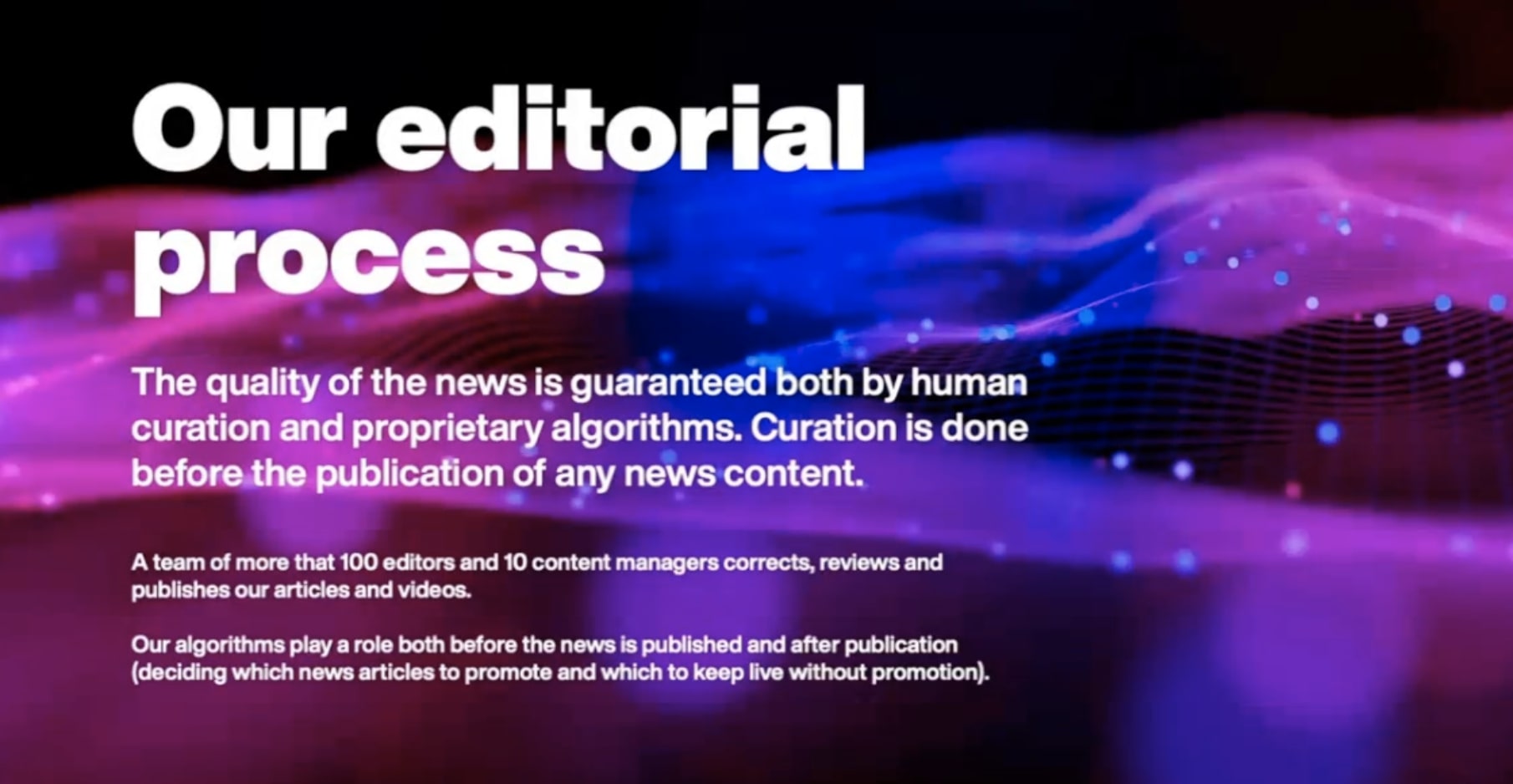
Editorial Workflow Design
Create efficient content processes with custom workflows, fact-checking controls, and community management strategies.
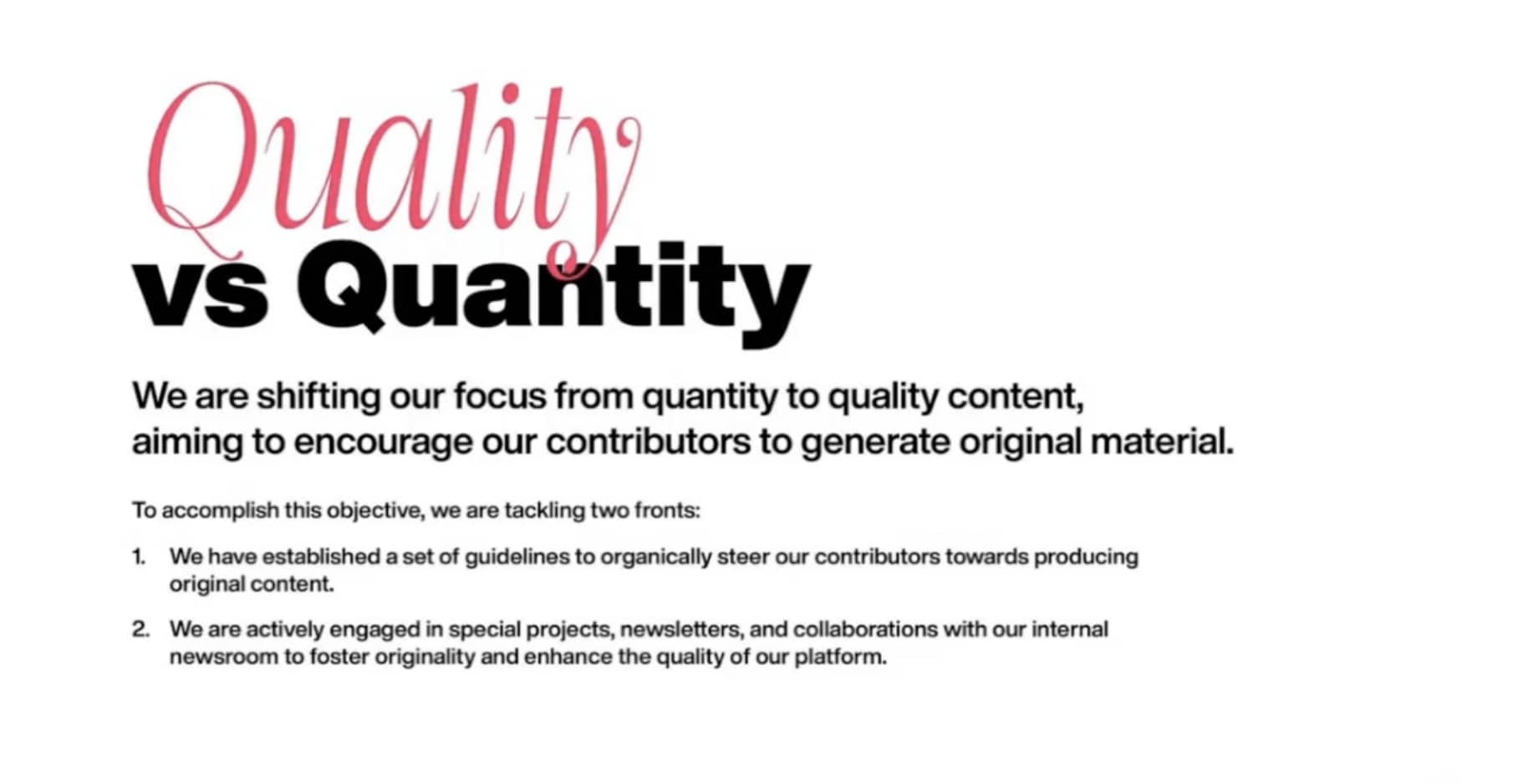
Community-Driven Content Creation
Explore how to build and manage a network of freelance contributors across multiple countries for diverse, high-quality content.
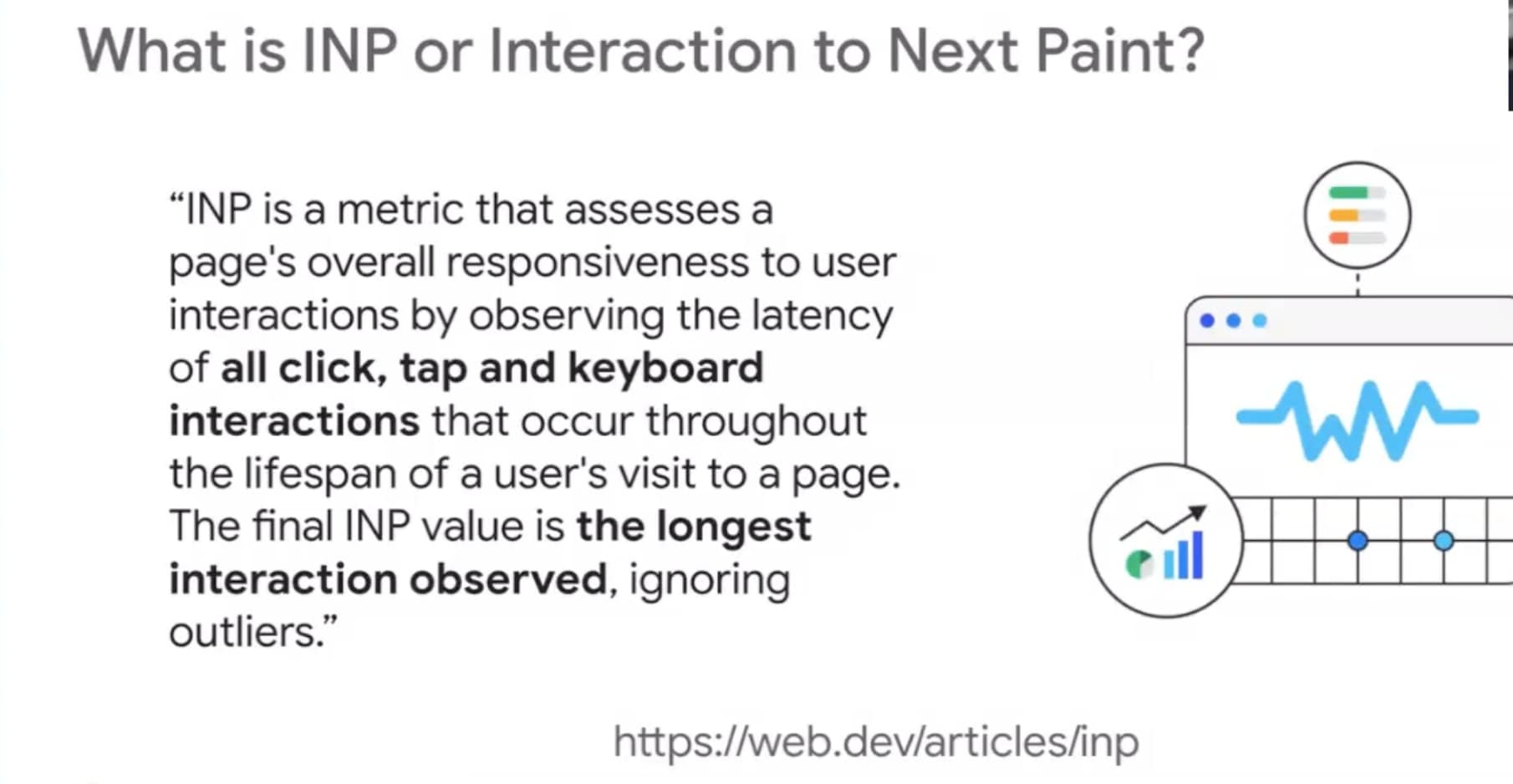
Core Web Vitals Improvement
Get insights on measuring and optimizing Largest Contentful Paint (LCP), Interaction to Next Paint (INP) & Cumulative Layout Shift.
Anti-Misinformation Strategies
Discover techniques to maintain content integrity, including fact-checking processes & AI-powered tools to detect potential fake news.
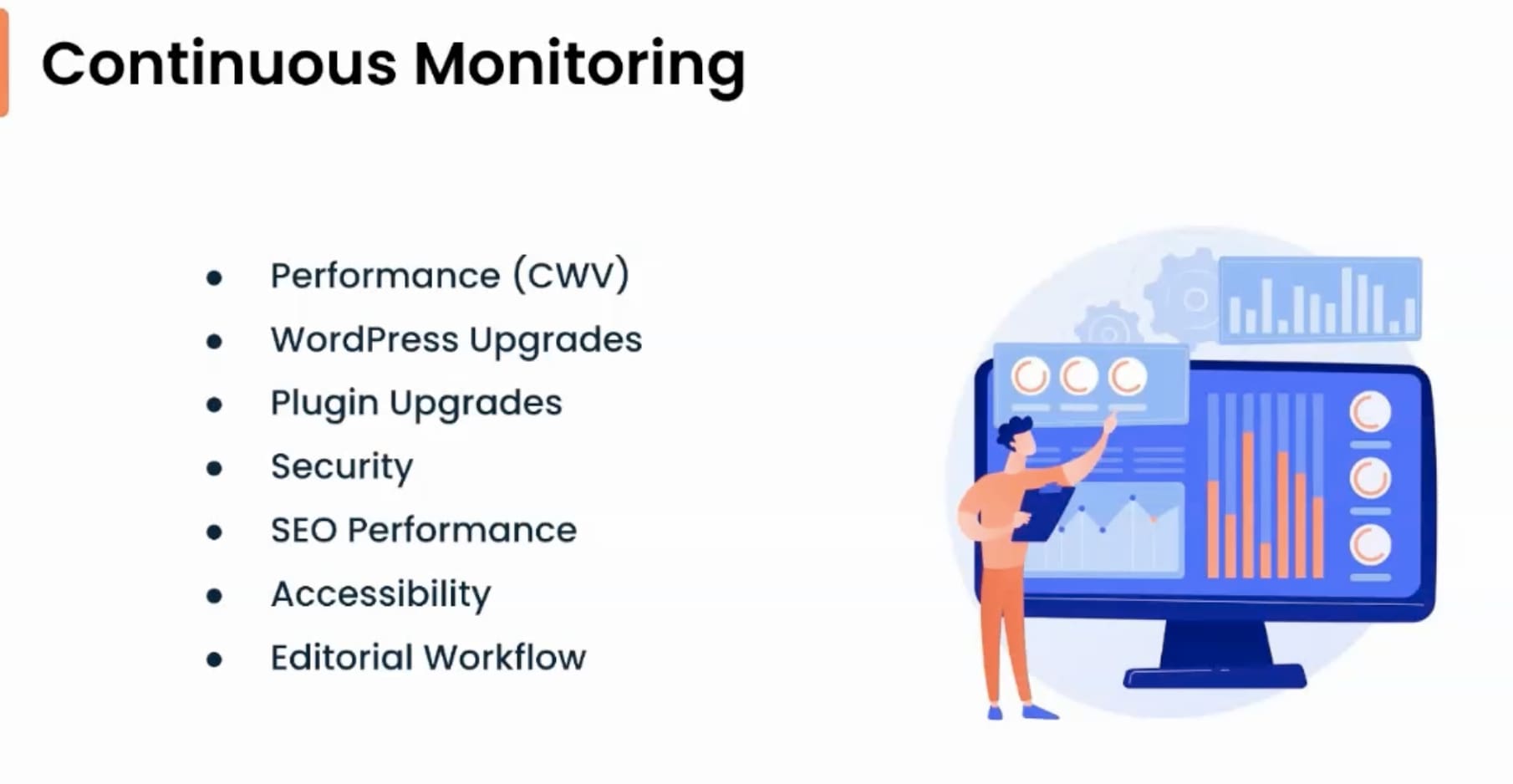
Continuous Performance Monitoring
Learn the importance of regular audits and how to set up ongoing checks for SEO, security, and accessibility.
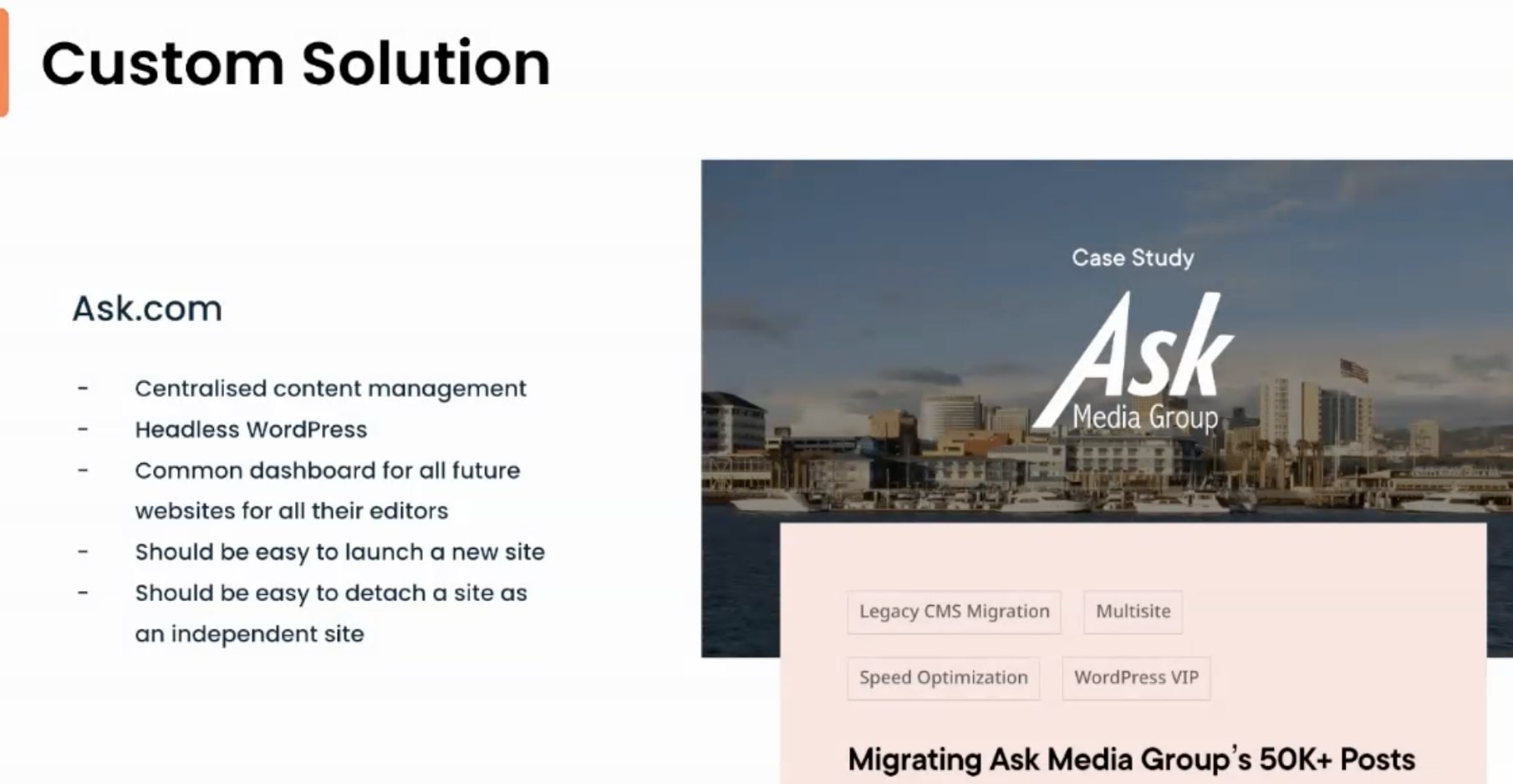
Custom Solutions for Unique Needs
See real-world examples of tailored WordPress solutions that solved specific publishing challenges for enterprise clients.
Time.com’s Bold Move: How Removing the Paywall Revived Traffic and Growth
Our Speakers

Jeremy Fremont
Director of Business Development
Jeremy Fremont is a digital solutions expert with over 15 years of experience helping both Fortune 500 companies and emerging startups build and grow their online presence. His expertise lies in the intersection of technology, content & business processes, making him qualified to analyze industry trends and shifts. Jeremy’s background in web design, development & performance optimization for various platforms gives him valuable insights into the technical challenges faced by enterprise publishers. His passion for creating value through digital innovation and his experience in eCommerce and accessibility provide him with an understanding of the digital publishing landscape.

Vahe Arabian
Founder and Editor in Chief
Vahe Arabian is the founder of State of Digital Publishing, bringing over 15 years of expertise in digital media publishing and SEO to the table. As a seasoned consultant, Vahe specializes in helping publishers optimize their online platforms for improved performance, user engagement, and revenue growth. His data-driven approach to content strategy and SEO has assisted numerous enterprise-level publishers in navigating the ever-changing digital landscape. Vahe’s insights are informed by his deep understanding of sustainable business models for digital media and his hands-on experience with search engine optimization, information architecture, and editorial operations.
Watch Session
In this special WordPress teardown series, Jeremy Fremont and Vahe Arabian explore Time.com, which removed its paywall on June 1, 2023. And with this came a clear traffic recovery and an expansion in the publication’s positioning and vertical expansion.
Time.com’s Playbook: Balancing Traffic, Content, and Revenue
A roadmap for publishers navigating the shift from paywalls to open access in the digital media landscape.

Paywall Removal Impact
Time.com saw a clear traffic recovery after removing its paywall in June 2023, expanding its audience reach and content positioning.
Newsletter Strategy
Time focuses heavily on growing newsletter subscriptions, offering tailored options for different content categories to engage readers.
Trending Content Integration
The site prominently features trending topics like Taylor Swift, broadening its appeal beyond traditional news and politics coverage.

Print Magazine Revival
Contrary to expectations, Time’s print magazine remains a premium asset, now marketed as a value-add to digital subscriptions.
Ad Strategy Evolution
The site incorporates video ads, native content, and brand partnerships, including controversial elements like Taboola feeds for monetization.
Content Traffic Drivers
Entertainment and coupon content surprisingly drive significant traffic, balancing Time’s historical and political coverage.
Harvard’s WordPress Success Story: Building a News Network That Serves 1.4 Million Monthly Users
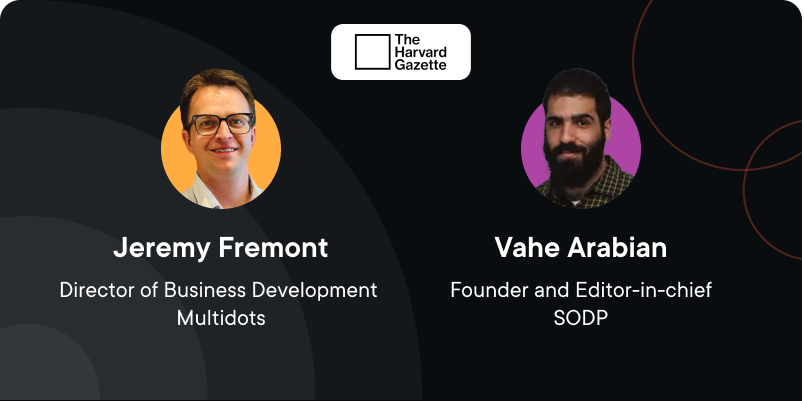
Our Speakers
Jeremy Fremont
Director of Business Development
Jeremy Fremont is a digital solutions expert with over 15 years of experience helping both Fortune 500 companies and emerging startups build and grow their online presence. His expertise lies in the intersection of technology, content & business processes, making him qualified to analyze industry trends and shifts. Jeremy’s background in web design, development & performance optimization for various platforms gives him valuable insights into the technical challenges faced by enterprise publishers. His passion for creating value through digital innovation and his experience in eCommerce and accessibility provide him with an understanding of the digital publishing landscape.
Vahe Arabian
Founder and Editor in Chief
Vahe Arabian is the founder of State of Digital Publishing, bringing over 15 years of expertise in digital media publishing and SEO to the table. As a seasoned consultant, Vahe specializes in helping publishers optimize their online platforms for improved performance, user engagement, and revenue growth. His data-driven approach to content strategy and SEO has assisted numerous enterprise-level publishers in navigating the ever-changing digital landscape. Vahe’s insights are informed by his deep understanding of sustainable business models for digital media and his hands-on experience with search engine optimization, information architecture, and editorial operations.
Watch Session
In this episode, Jeremy Fremont and Vahe Arabian analyze The Harvard Gazette’s WordPress implementation and content distribution strategy. They explore how Harvard manages its massive network of department microsites, examine the technical architecture that serves 1.4 million monthly users, and break down the design decisions that make the platform successful.
Inside Harvard’s Enterprise WordPress Architecture: Key Lessons for Digital Publishers
A detailed breakdown of Harvard Gazette’s WordPress implementation, from content distribution network to performance optimization strategies.

Powering Content at Scale
Harvard Gazette’s WordPress implementation drives 231K monthly organic users on their main site, while news.harvard.com pulls in 1.4M users monthly, outperforming other prestigious university news sites like Stanford and MIT by a significant margin.

Harvard’s WordPress Network
The WordPress architecture connects and manages over 100 department microsites through a central installation. Their custom content syndication system automatically distributes stories across multiple department websites while maintaining consistent branding and performance.

Technical Foundation
Harvard’s implementation includes dynamic image resizing and responsive design optimized specifically for mobile users. The clean navigation structure features a visually rich hamburger menu, with lightning-fast search functionality working seamlessly across all connected microsites.
Strategic Homepage Design
Harvard’s homepage showcases three featured articles using custom post types, backed by an intelligent content categorization system. Their automated content refresh system adjusts featured content based on real-time engagement metrics.

Enterprise-Level Performance
Harvard implemented server-side rendering to achieve faster page loads across their network. Their custom caching system and optimized database queries handle massive traffic volumes while maintaining performance.

Multi-Site Content Management
The multi-site WordPress configuration gives departments independence while enforcing centralized style guidelines. Their automated content syndication rules, based on sophisticated category and tag systems, ensure content reaches the right audiences.